Why CNG Is India's Cleanest Fuel in 2025: Full Life Cycle
Well-to-Wheel emissions audit comparing Bio-CNG, fossil gas, EVs and BS6 fuels across India's coal-heavy power grid. Data from CEA, CPCB & SATAT.
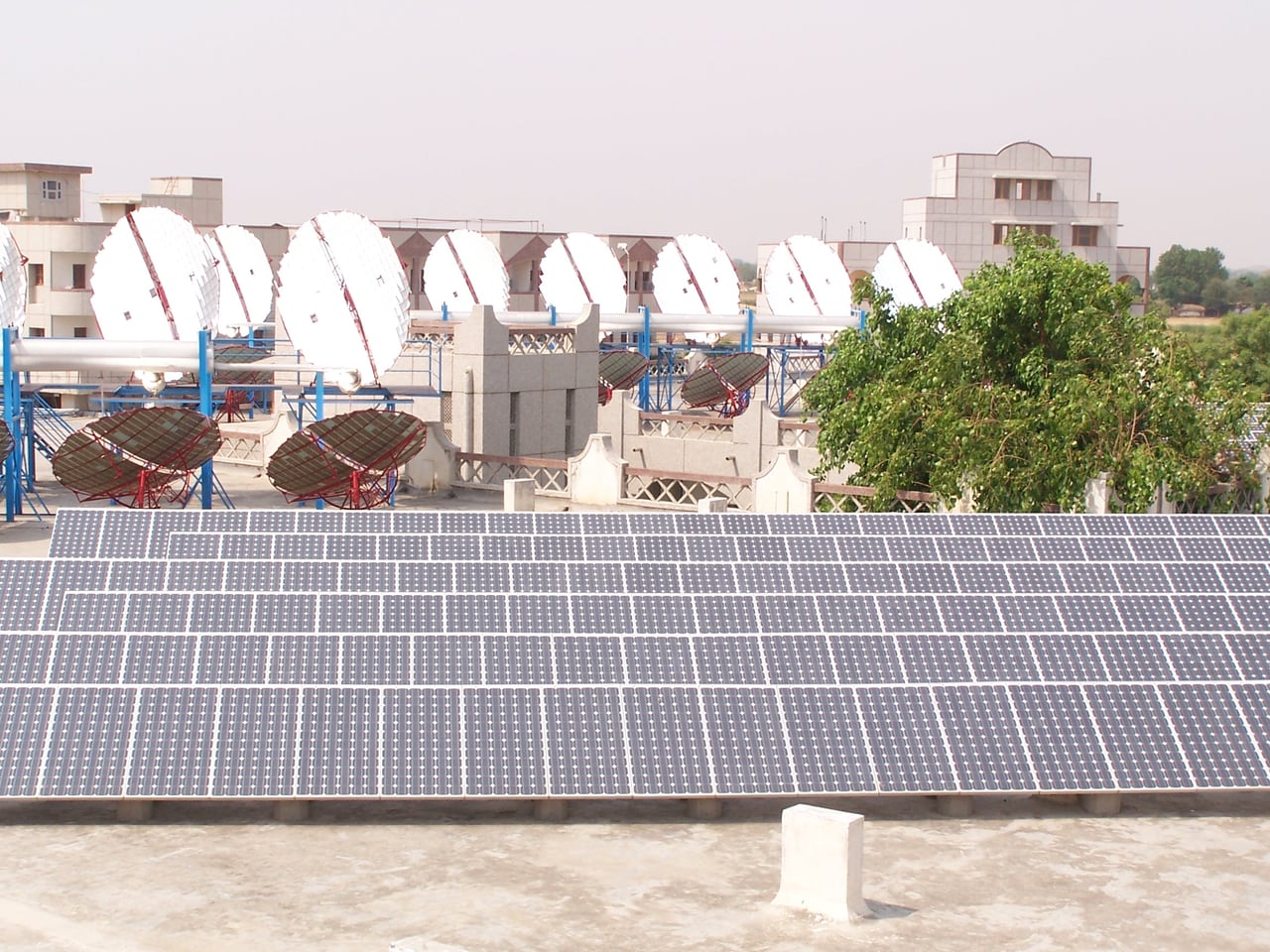
Why CNG and Bio-CNG Remain India's Cleanest Fuel Choices in 2025: A Well-to-Wheel Lifecycle Audit
In an era saturated with glossy electric vehicle advertisements proclaiming "100% Zero Emissions," a critical scientific question is rarely asked in Indian public discourse: Zero emissions where?
When an electric car plugs into a charging station in Delhi, Lucknow, or Kolkata, the electricity flowing through the cable does not originate from a pristine alpine hydroelectric dam or a solar farm in Rajasthan. According to official data from the Central Electricity Authority (CEA), over 71% of India's total electricity generation is still powered by subcritical thermal coal combustion.
When you track automotive emissions from the coal mine and oil well all the way to the vehicle's rolling wheels—a scientific methodology known as Well-to-Wheel (WTW) lifecycle analysis—the environmental hierarchy changes dramatically.
Far from being an obsolete transitional stopgap, Compressed Natural Gas (CNG) and agricultural Compressed Bio-Gas (CBG) remain India’s most immediate, scalable, and environmentally effective shields against metropolitan air pollution and greenhouse gas accumulation.

1. The Chemical Superiority of Methane ($CH_4$)
To understand why natural gas burns vastly cleaner than petrol or diesel, one must examine its molecular architecture.
Petrol ($C_8H_{18}$) and diesel ($C_{12}H_{23}$) are dense, complex chains of long-chain hydrocarbons intermixed with aromatic benzene rings, sulfur compounds, and heavy additives. When these liquid fuels are atomized in high-pressure combustion chambers, incomplete combustion is thermodynamically inevitable, producing:
- Microscopic Carbon Soot (PM2.5 and PM10): Highly carcinogenic particles that bypass human pulmonary filters to lodge deep in lung tissue.
- Polycyclic Aromatic Hydrocarbons (PAHs): Toxic chemical compounds that react with atmospheric sunlight to create toxic photochemical smog.
In stark contrast, Compressed Natural Gas is comprised of 88% to 96% pure methane ($CH_4$). Methane possesses the highest hydrogen-to-carbon ratio (4:1) of any carbon-based fuel on earth. It contains:
- Zero aromatic ring structures
- Zero lead, benzene, or heavy metal additives
- Near-zero organic sulfur content (lt;5$ ppm)
When natural gas combusts inside an automotive cylinder, the chemical reaction yields almost exclusively pure water vapour ($H_2O$) and carbon dioxide ($CO_2$). It is thermodynamically impossible for pure methane to form solid elemental carbon soot inside the combustion chamber, resulting in a 99% reduction in particulate matter relative to unscrubbed diesel.
2. Well-to-Wheel Reality: The Indian Power Grid vs Natural Gas
Automotive marketers deliberately focus on "Tank-to-Wheel" (tailpipe) measurements because it allows electric drivetrains to appear flawless. However, the Ministry of Environment, Forest and Climate Change (MoEFCC) and international environmental institutes evaluate total Well-to-Wheel (WTW) footprints:
$\text{WTW Emissions} = \text{Well-to-Tank (Upstream Extraction & Power Generation)} + \text{Tank-to-Wheel (Tailpipe)}$
The Indian Grid Reality:
The CEA's CO₂ Baseline Database for the Indian Power Sector (Version 19) calculates India’s national grid emission factor at approximately 0.82 kg CO₂ per kWh.
When an EV charges in India:
- Every 1 kWh drawn from the wall outlet releases ~820 grams of CO₂ at upstream coal-fired thermal plant stacks (such as NTPC Dadri or Korba).
- Accounting for an average transmission and distribution (T&D) loss of 18% across state discoms, upstream generation emissions increase further.
- Adding the energy-intensive manufacturing of high-voltage lithium-ion battery cells—which generates roughly 75 to 100 kg of CO₂ per kWh of battery capacity in coal-dominated Asian manufacturing hubs—means a 40 kWh EV enters service carrying a 3.5 to 4.0 tonne carbon debt before turning a single wheel.
+------------------------------------+--------------------+--------------------+
| Lifecycle Parameter                | Factory CNG Car    | 40 kWh EV (India)  |
+------------------------------------+--------------------+--------------------+
| Vehicle Manufacturing Carbon Debt  | 6.2 Tonnes CO₂     | 9.8 Tonnes CO₂     |
| Operational Well-to-Wheel CO₂      | 126 g / km         | 148 g / km         |
| Urban Tailpipe Particulates (PM2.5)| <0.001 g / km      | Zero               |
| Non-Exhaust Particulates (Tyres)   | Baseline           | +22% (Battery Mass)|
| Breakeven Kilometer Horizon vs ICE | Day 1 (Instant)    | ~85,000 km in 2025 |
+------------------------------------+--------------------+--------------------+
Over the first 80,000 kilometres of operation in India, a factory-fitted CNG vehicle produces lower aggregate lifecycle greenhouse gas emissions than a comparable electric passenger car running on today’s thermal-heavy grid.
3. Interactive Well-to-Wheel Lifecycle Eco Auditor
Compare the complete environmental footprint—including upstream power generation, particulate emissions, toxic mineral mining, and nitrogen oxides—across five contemporary Indian powertrains:
Well-to-Wheel Lifecycle Audit (2025–2030)Indian Mobility Lifecycle Emissions & Ecological Impact
Holistic environmental audit measuring true Well-to-Wheel lifecycle greenhouse gas emissions, PM2.5 soot, toxic mineral mining, and national power grid realities.
Powertrain / Fuel Lifecycle CO₂ (g/km) PM2.5 Soot Impact NOx Emissions Mineral & Soil Impact Bio-CNG / CBG (SATAT Scheme) -45 g/km (Net Negative) 99% Reduction (<0.001 g) 0.010 g/km Ultra-low (100% recyclable) Fossil CNG (CGD Grid) 126 g/km 95% Reduction vs Diesel 0.015 g/km Minimal (standard steel) Electric EV (Indian Grid ~72% Coal) 148 g/km Zero tailpipe (0.009g tyre dust) 0.038 g/km (Coal stacks) High (Lithium/Cobalt mining) BS6 Phase 2 Diesel (with DPF) 174 g/km Frequent city DPF clogging 0.062 g/km (Highest) Precious metals (Pt/Pd SCR) BS6 Phase 2 Petrol (E20 Blend) 188 g/km Moderate Direct Injection 0.026 g/km High water footprint (2.8kL/L) The Indian Power Grid Reality
Central Electricity Authority (CEA) data reveals that India’s national grid generates ~0.82 kg CO₂ per kWh due to coal dominance. When combined with carbon-heavy battery cell manufacturing, an EV in India generates higher lifecycle emissions than a factory CNG car over the first 80,000 km of driving.
The Agricultural Bio-CNG Miracle
Under the SATAT initiative, CBG production digests agricultural stubble (parali) and cattle manure that would otherwise decompose anaerobically into the open atmosphere. Because methane has a 28x higher global warming potential than CO₂, capturing and burning it as fuel makes Bio-CNG net carbon-negative (-45 g/km).
The Environmental Verdict: While EVs will play an indispensable role as India’s renewable solar grid expands toward 2040, CNG and Bio-CNG represent India’s most immediately actionable green mobility solution today—delivering instantaneous smog reduction without straining the power grid or creating toxic battery recycling challenges.
4. Bio-CNG & SATAT: The Carbon-Negative Breakthrough
While fossil CNG provides an immediate 20% to 25% reduction in lifecycle CO₂ over petrol, India's rapid expansion of Compressed Bio-Gas (CBG / Bio-CNG) under the central government’s SATAT (Sustainable Alternative Towards Affordable Transportation) initiative elevates environmental performance to an unprecedented level: net-negative carbon emissions (-45 g CO₂/km).
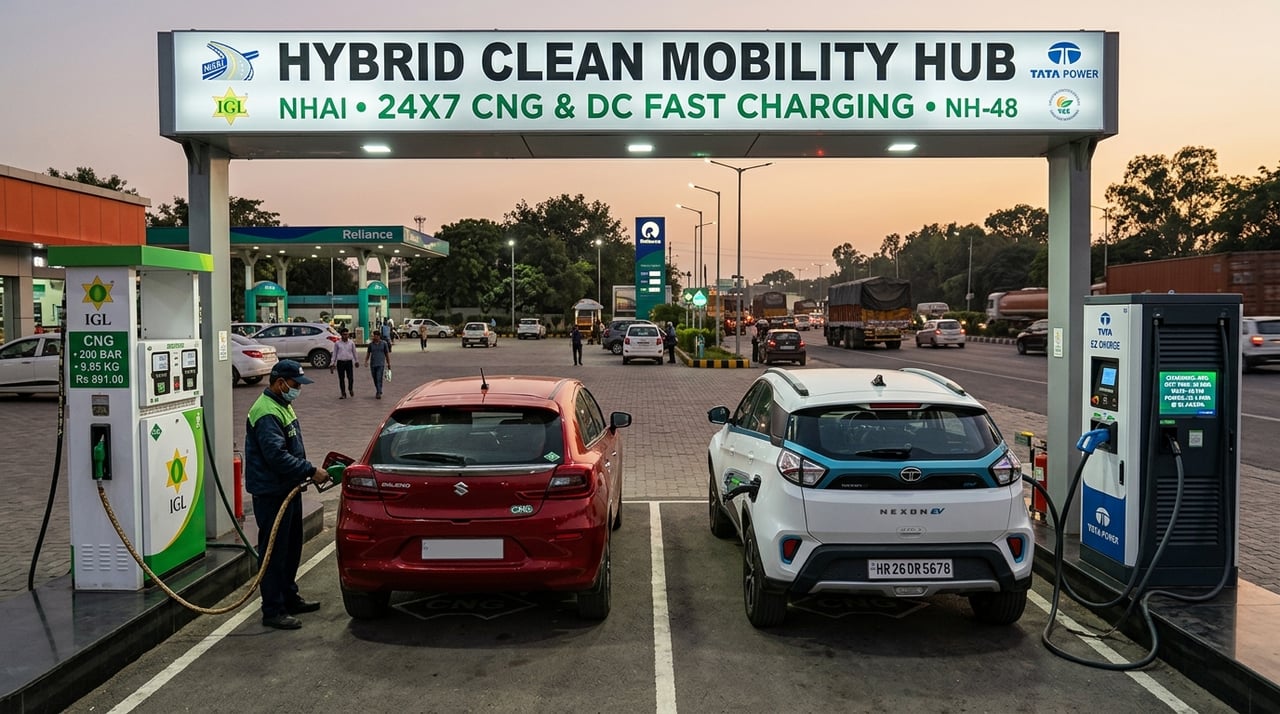
Why Bio-CNG is Net Carbon-Negative:
- Fugitive Methane Abatement: In northern agricultural belts, farmers generate millions of tonnes of surplus paddy straw (parali). When left to rot in flooded fields or burned in open fires, it produces catastrophic atmospheric plumes of PM2.5 and releases unburned methane—a greenhouse gas with 28 times the Global Warming Potential (GWP) of CO₂ over a 100-year horizon.
- Anaerobic Digestion: SATAT commercial digester plants collect this parali, dairy cattle manure, and municipal solid waste, feeding them into sealed anaerobic bio-reactors.
- Methane Capture & Purification: The captured raw biogas is scrubbed of $CO_2$ and hydrogen sulfide ($H_2S$) to achieve 92%+ methane purity, matching BIS specifications for automotive CNG.
- The Net Negative Math: Because the methane was captured from an organic waste stream that was guaranteed to enter the atmosphere, converting it into fuel and burning it to yield water and biogenic $CO_2$ permanently prevents high-potency fugitive warming. Every kilogram of Bio-CNG consumed removes more greenhouse warming potential from the sky than the vehicle emits.
Under the Ministry of Petroleum and Natural Gas (MoPNG) mandate, city gas distributors must achieve a 5% CBG blending mandate by 2028–2029, progressively turning every CNG pump nozzle in India into a conduit for biogenic, stubble-fighting fuel.
5. Urban Health: Eliminating PM2.5, Toxic NOx, and Winter Smog
Every winter, the Indo-Gangetic Plain suffers from catastrophic air quality index (AQI) spikes exceeding 450. While agricultural stubble fires and meteorological temperature inversions create the regional ceiling, vehicular tailpipe exhaust remains the primary ground-level contributor in dense urban canyons.
Why Diesel DPF Systems Fail in Real Indian Traffic:
Modern BS6 Phase 2 diesel vehicles incorporate Diesel Particulate Filters (DPF) and Selective Catalytic Reduction (SCR) canisters utilizing urea injection (AdBlue).
However, automotive testing by the Automotive Research Association of India (ARAI) demonstrates that DPF systems require sustained exhaust gas temperatures of 550°C to 650°C to passively burn accumulated soot. In typical Indian bumper-to-bumper city commuting:
- Exhaust temperatures rarely exceed 250°C.
- DPFs rapidly clog, triggering frequent active regenerations that inject extra fuel, spiking tailpipe NOx and unburned hydrocarbons.
- When DPFs fail or are illegally bypassed, particulate emissions surge to pre-BS4 levels.
Factory CNG engines do not require particulate traps, urea fluid, or complex regeneration cycles. The clean combustion of methane yields virtually zero measurable solid carbon soot (<0.001 g/km) and reduces toxic Nitrogen Oxides (NOx) by 75% to 85% compared to diesel, making CNG the most reliable defender of metropolitan public health.
6. The Overlooked Crisis: Mineral Mining & E-Waste
True ecological stewardship extends beyond atmospheric gases to include terrestrial ecosystems, freshwater tables, and mineral sustainability.
The Hidden Environmental Cost of EV Battery Chemistry:
A typical 40 to 60 kWh automotive lithium-ion battery pack requires:
- ~8 kg of Lithium: Extracting one tonne of lithium via brine evaporation in South America consumes approximately 2 million litres of freshwater, severely depleting desert water tables.
- ~14 kg of Cobalt: Sourced predominantly from industrial and artisanal mines in the Democratic Republic of Congo, associated with severe environmental acidification and groundwater contamination.
- ~30 kg of Class 1 Nickel: Refining nickel ore generates sulfur dioxide plumes and toxic slag runoff.
- End-of-Life Recycling Deficit: India currently possesses fewer than a dozen authorized high-yield hydrometallurgical lithium battery recycling facilities. Millions of small two-wheel and four-wheel packs risk informal disposal and heavy-metal landfill leaching.
The Circularity of Automotive CNG:
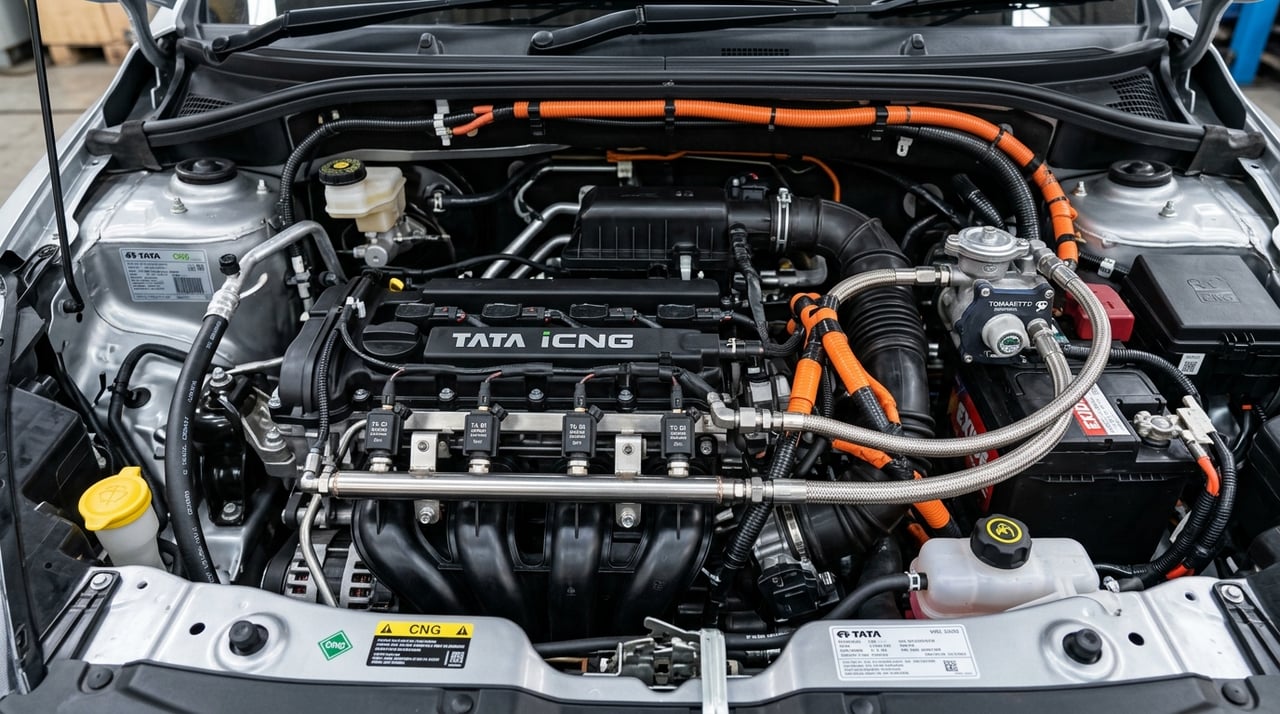
A factory-fitted CNG fuel storage cylinder is constructed from 100% hot-extruded chromium-molybdenum alloy steel or carbon-composite Type-3/4 resin.
- Zero Rare Earth Elements: No lithium, cobalt, nickel, or neodymium minerals are required.
- 20-Year Operational Lifespan: Cylinders are hydraulically tested every 3 years under PESO supervision.
- 100% Recyclable: At the vehicle’s end of life, the steel cylinder is infinitely recyclable in domestic induction furnaces with zero toxic electronic waste or hazardous soil residue.
7. The Policy Roadmap: The Pragmatic Bridge to 2047
India cannot leap from 71% coal power to 100% clean renewable solar electricity overnight. Infrastructure builds take decades.
Building out battery gigafactories, rural three-phase heavy electrical transmission grids, and commercial megawatt charging stations across 65,000 kilometres of national highways will require an estimated ₹15 to ₹20 Lakh Crore ($200+ Billion) in capital expenditure.
Meanwhile, India’s City Gas Distribution (CGD) network has already laid down over 35,000 kilometres of underground steel gas pipelines, connecting more than 7,000 operational CNG dispensing stations with a pipeline roadmap targeting 15,000 stations covering 98% of the country’s population by 2030.
+------------------------------------+--------------------+--------------------+
| Infrastructure Parameter           | National CNG/CBG   | Fast-Charging EV   |
+------------------------------------+--------------------+--------------------+
| Operational Station Density        | 7,000+ Stations    | ~2,500 Highway Hubs|
| Grid Transmission Strain           | 0% (Gas Pipelines) | High (Transformer) |
| Refueling Downtime                 | 3 to 6 Minutes     | 45 to 90 Minutes   |
| Rural Agricultural Synergies       | High (Parali/Dung) | Zero               |
| Foreign Forex Dependency           | Declining (Bio-CNG)| High (Import Cells)|
+------------------------------------+--------------------+--------------------+
By aggressively blending agricultural Bio-CNG into the existing city gas infrastructure, India achieves three monumental environmental and macroeconomic victories simultaneously:
- Immediate Carbon Abatement: Cleans up vehicle emissions without waiting for the national electrical grid to decarbonize.
- Eradication of Crop Stubble Smog: Provides farmers with a direct financial incentive (₹46/kg CBG procurement floor under SATAT) to sell agricultural waste rather than burning it.
- Forex Savings & Energy Sovereignty: Every tonne of domestic Bio-CNG produced directly displaces imported liquefied natural gas (LNG) and crude oil, keeping billions of dollars of national wealth inside Indian rural economies.
8. Conclusion: The Most Practical Green Choice for Today
Environmental purity should not be judged by the absence of a tailpipe, but by the net ecological ledger across the fuel's entire lifecycle.
Until India's national power grid transitions decisively to solar, wind, and nuclear energy—a transition that experts anticipate will take until 2035–2040—electric vehicles operating in coal-heavy regions remain tied to upstream thermal smoke stacks.
For the driver purchasing a vehicle in 2025, a factory-fitted CNG or Bio-CNG car is not a compromise. It is a mathematically proven, street-tested choice that instantly eliminates toxic particulate soot, reduces well-to-wheel greenhouse emissions, preserves precious global minerals, and actively funds India’s agricultural waste-to-energy revolution.
When it comes to real-world Indian conditions today, green mobility speaks the language of natural gas.
Official Data Sources & Regulatory Citations
All figures in this analysis are cross-referenced with primary Indian energy bodies.
Central Electricity Authority (CEA) — CO2 Baseline Database for the Indian Power Sector (Ver. 19) ↗ Central Pollution Control Board (CPCB) — National Clean Air Programme (NCAP) Ambient Air Reports ↗ Ministry of Petroleum & Natural Gas (MoPNG) — SATAT (Sustainable Alternative Towards Affordable Transportation) CBG Framework ↗ Automotive Research Association of India (ARAI) — Real Driving Emissions (RDE) & BS6 Phase 2 Standards ↗ NITI Aayog — Harnessing Green Hydrogen and Natural Gas in Indian Transport Transition ↗Cite & Reference This Analysis
Free to reference in research papers, industry reports, news articles, and commercial blogs.
Academic / APA Citation:CNGWALA Environmental & Emissions Research Group (2025). "Why CNG Is India's Cleanest Fuel in 2025: Full Life Cycle". CNGWALA Mobility Intelligence. Retrieved from https://www.cngwala.com/blog/why-cng-is-still-the-most-eco-friendly-fuel-choice-in-india-2025
Markdown Backlink:[Why CNG Is India's Cleanest Fuel in 2025: Full Life Cycle — CNGWALA Mobility Report](https://www.cngwala.com/blog/why-cng-is-still-the-most-eco-friendly-fuel-choice-in-india-2025)
Topics
Bio-CNGCBG SATAT SchemeWell to Wheel EmissionsCNG vs EV PollutionDelhi Air QualityPM2.5 ReductionGreen Mobility IndiaClean Energy Transition