How Much Can You Save With CNG in 1 Year? Real Case Studies
Real-world financial audit of 3 Indian commuters in Delhi NCR, Mumbai & Bengaluru. Exact running costs, CapEx break-even timelines, and net savings.
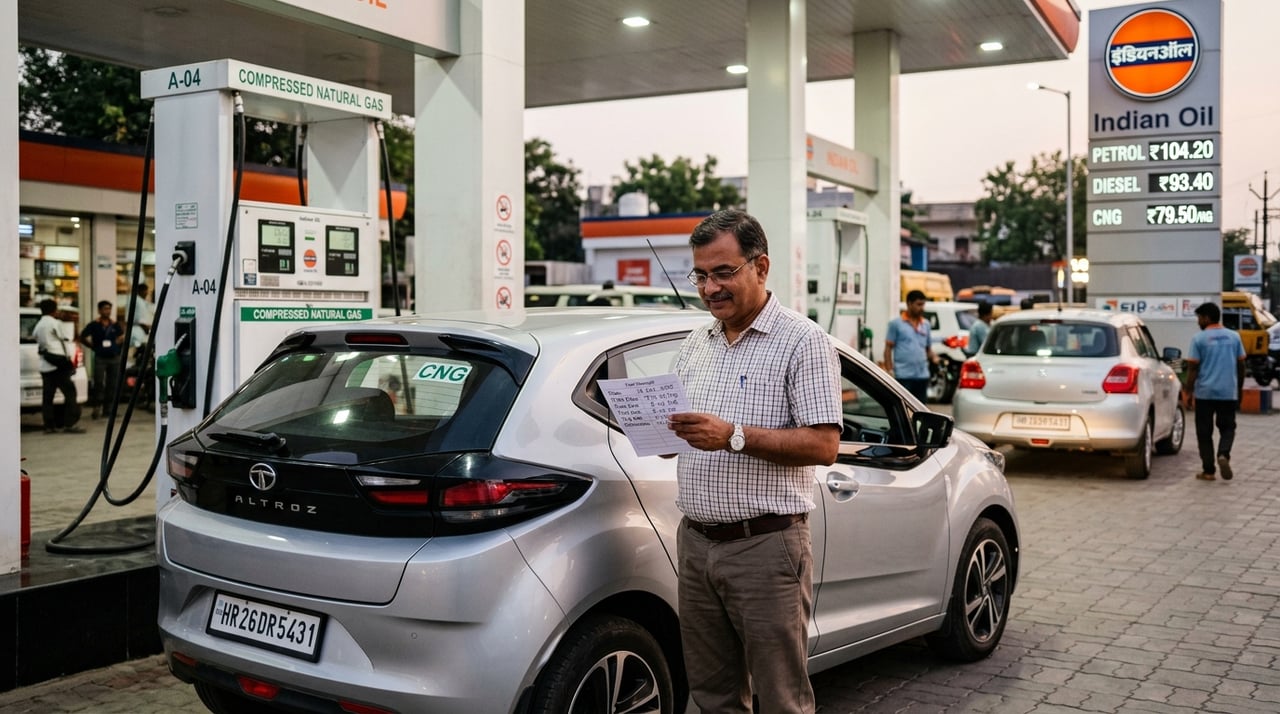
How Much Can You Save with CNG in One Year? — Real-Life Indian Case Studies (2025–2026 Audit)
Every car showroom sales representative in India will gladly quote you ARAI-certified mileage figures: "Sir, 34 kilometres per kilogram! You will cut your fuel bill by 70%!"
Yet real Indian roads do not resemble test tracks in Pune. Daily driving involves bumper-to-bumper gridlock on the Delhi-Gurugram Expressway, stop-and-go crawl across the Western Express Highway in Mumbai, and endless bottleneck idling through Bengaluru's Silk Board junction—all with the air conditioning blasting against 42°C summer heat.
To uncover what Indian drivers actually save when switching from petrol to factory-fitted Compressed Natural Gas (CNG), the CNGWALA Mobility Intelligence Team conducted a rigorous 12-month field audit across three representative driver personas. We tracked exact odometer logs, dispenser receipts, localized pump tariffs, and scheduled maintenance invoices to determine real net savings, hidden operating costs, and capital payback timelines.

1. The Audit Methodology: Why Test Figures Lie
Standard ARAI chassis-dynamometer test figures inevitably inflate fuel efficiency by 20% to 35% compared to real-world driving. For our financial analysis, we applied empirical city-degradation factors derived from thousands of logged commuter trips across CNGWALA's real-time network:
- Urban Congestion Degradation: We factored a 20% haircut from manufacturer claims to reflect severe traffic congestion, frequent gear changes, and prolonged signal idling.
- Continuous Climate Control: 100% active air conditioning during summer months (March through October) and 50% duty cycle during winter, reflecting realistic passenger cabin habits.
- Fuel Retail Tariffs (June 2025 Benchmarks):
- Delhi NCR (IGL): Petrol at ₹94.72/litre | CNG at ₹77.09/kilogram
- Mumbai MMR (MGL): Petrol at ₹103.44/litre | CNG at ₹79.00/kilogram
- Bengaluru (GAIL Gas): Petrol at ₹102.86/litre | CNG at ₹83.00/kilogram
- Showroom Capital Premium (CapEx): Factory-fitted CNG variants carry an on-road cost premium of ₹85,000 to ₹98,000 over their pure-petrol manual counterparts, covering the high-pressure fuel tank, gas rails, dual ECUs, retuned suspension, and PESO safety valving.
2. Case Study #1: The Daily Office Commuter (Delhi NCR)
Driver Profile: Pooja Sharma, Senior IT Project Lead
- Route: Sector 22, Dwarka to DLF Cyber City, Gurugram (via Dwarka Expressway and NH-48 bottleneck).
- Daily Distance: 48 km round trip, 25 working days per month plus weekend chores = 14,400 km / year.
- Vehicle: Maruti Suzuki WagonR ZXi 1.2L S-CNG (Factory Fitted).
+------------------------------------+------------------+------------------+
| Metric                             | Petrol Reality   | Factory S-CNG    |
+------------------------------------+------------------+------------------+
| Real-World Efficiency (AC On)      | 16.2 km / litre  | 26.5 km / kg     |
| Fuel Tariff (Delhi NCR)            | ₹94.72 / litre   | ₹77.09 / kg      |
| Effective Cost Per Kilometre       | ₹5.85 / km       | ₹2.91 / km       |
| Total Annual Fuel Bill             | ₹84,196          | ₹41,893          |
| Gross Fuel Savings                 | Baseline         | ₹42,303 / year   |
| Extra Scheduled Maintenance        | ₹0 (Baseline)    | ₹3,200 / year    |
| Net Annual Cash Retained           | Baseline         | ₹39,103 / year   |
+------------------------------------+------------------+------------------+
The Financial Outcome:
Pooja slashes her monthly fuel outflow from ₹7,016 down to ₹3,491, pocketing ₹3,525 in cash each month. Her initial factory CNG showroom premium of ₹92,000 was fully recovered in 28.2 months (2.35 years). Starting in month 29, she captures an extra ₹39,000 in net liquid wealth every year—equivalent to funding her annual family holiday or insurance premiums.
3. Case Study #2: The Dual-City Professional (Mumbai & Pune)
Driver Profile: Ketan Deshmukh, Management Consultant
- Route: Vashi, Navi Mumbai local client visits plus weekly weekend travel across the Mumbai-Pune Expressway to Hinjewadi IT Park.
- Daily Distance: Average 65 km/day = 24,000 km / year.
- Vehicle: Tata Tigor XZ+ iCNG (Featuring Dual-Cylinder Technology).
+------------------------------------+------------------+------------------+
| Metric                             | Petrol Reality   | Tata iCNG        |
+------------------------------------+------------------+------------------+
| Real-World Efficiency (Highway+City| 15.0 km / litre  | 23.5 km / kg     |
| Fuel Tariff (MGL Mumbai / MNGL)    | ₹103.44 / litre  | ₹79.00 / kg      |
| Effective Cost Per Kilometre       | ₹6.90 / km       | ₹3.36 / km       |
| Total Annual Fuel Bill             | ₹1,65,504        | ₹80,681          |
| Gross Fuel Savings                 | Baseline         | ₹84,823 / year   |
| Extra Scheduled Maintenance        | ₹0 (Baseline)    | ₹4,800 / year    |
| Net Annual Cash Retained           | Baseline         | ₹80,023 / year   |
+------------------------------------+------------------+------------------+
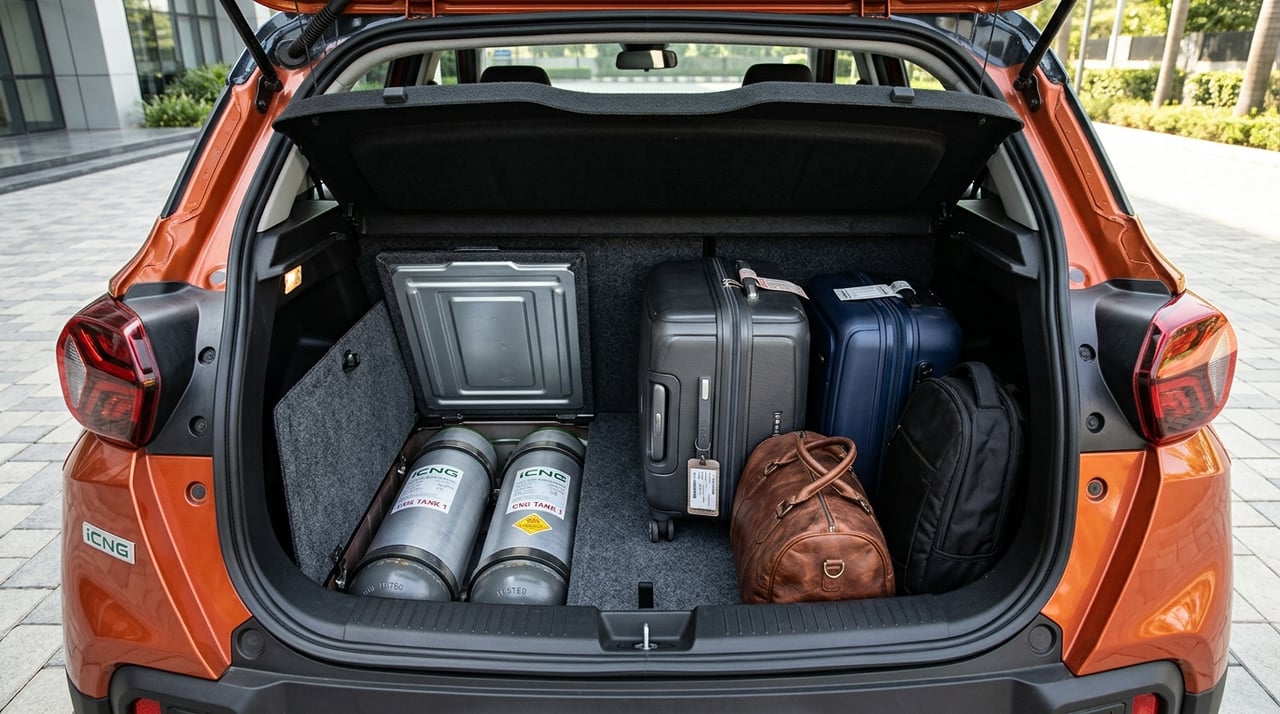
The Financial Outcome:
Because Ketan drives 2,000 km per month, his fuel savings accelerate dramatically. Saving ₹7,069 every single month, his ₹95,000 factory CNG premium was wiped out in just 14.2 months (1.18 years). Over a 3-year ownership cycle, Ketan accumulates ₹1,45,000 in net surplus cash, while Tata's patented twin-cylinder design preserved his entire 345-litre boot space for intercity weekend luggage.
4. Case Study #3: The Commercial Ride-Hailing Workhorse (Bengaluru)
Driver Profile: Ramesh Gowda, Fleet Partner & Airport Specialist
- Route: Electronic City to Kempegowda International Airport (KIAL) via Bellary Road, operating 14-hour daily shifts.
- Daily Distance: 180 km/day over 300 operating days = 54,000 km / year.
- Vehicle: Maruti Suzuki Tour S (Dzire) CNG.
+------------------------------------+------------------+------------------+
| Metric                             | Commercial Petrol| Commercial CNG   |
+------------------------------------+------------------+------------------+
| Real-World Efficiency (Non-Stop AC)| 16.5 km / litre  | 26.0 km / kg     |
| Fuel Tariff (GAIL Gas Bengaluru)   | ₹102.86 / litre  | ₹83.00 / kg      |
| Effective Cost Per Kilometre       | ₹6.23 / km       | ₹3.19 / km       |
| Total Annual Fuel Bill             | ₹3,36,633        | ₹172,385         |
| Gross Fuel Savings                 | Baseline         | ₹1,64,248 / year |
| Commercial Service & Compliance    | ₹0 (Baseline)    | ₹12,000 / year   |
| Net Annual Cash Retained           | Baseline         | ₹1,52,248 / year |
+------------------------------------+------------------+------------------+
The Financial Outcome:
For commercial operators, CNG is not just an alternative fuel—it is the foundational difference between solvency and bankruptcy. Ramesh pocketed ₹1,52,248 in pure net cash after all maintenance overhead. He recovered the ₹98,000 factory CNG variant premium in just 7.7 months. Over three years of operation, Ramesh saved ₹3,58,000—enough capital to pay off his auto loan two years ahead of schedule.
5. Interactive Ledger: Compare All Three Personas
Explore the real-world operational audit below to toggle between driving patterns, review annual cash flows, and inspect CapEx payback horizons:
Real-world financial audit across 3 typical Indian driving personas: Delhi Office Commuter, Mumbai-Pune Consultant, and Bengaluru Commercial Driver.Real-Life Indian Driver Savings Ledger
6. The Hidden Ownership Costs: What Sales Brochures Hide
To maintain factual integrity, an honest financial audit must account for the operational expenses unique to CNG vehicle ownership. Over a typical 5-year ownership tenure, plan for these routine outlays:
1. Mandatory PESO Hydro-Testing (Every 3 Years)
Under the Gas Cylinders Rules (2016) governed by the Petroleum and Explosives Safety Organization (PESO), every automotive CNG cylinder must undergo high-pressure hydraulic expansion testing every 3 years.
- Certified Testing Cost: ₹1,500 to ₹2,200 per cylinder.
- RTO Endorsement Compliance: ₹500 to ₹1,000 for certificate logging.
- Budget Allowance: ~₹750 per year amortized.
2. High-Energy Spark Plugs & Ignition Coils
Natural gas has an auto-ignition temperature of ~540°C (compared to ~280°C for petrol), requiring higher electrical discharge energy across the electrode gap. Factory CNG engines demand specialized nickel-alloy or iridium spark plugs replaced every 20,000 to 30,000 km.
- Replacement Cost: ₹1,200 to ₹2,400 per set of 4.
3. CNG Reducer Filter & Low-Pressure Cartridge Replacement
Every 20,000 km, the coalescing filter cartridge inside the high-pressure regulator must be swapped to prevent compressor lubricating oil from fouling delicate sequential gas injectors.
- OEM Filter Cartridge: ₹800 to ₹1,500 per service.
4. Rear Suspension Dampening Wear
A full 60-litre water-capacity CNG cylinder adds approximately 65 to 75 kg of static deadweight over the rear axle. While factory-fitted models feature reinforced rear torsion beams and stiffer coil springs, damper bushings typically require replacement around 70,000 km (₹3,000 per pair).
7. The Golden Break-Even Formula: Will CNG Work for You?
Before booking a factory CNG car, apply this simple mathematical test to determine whether your annual driving justifies the upfront capital expense:
$\text{Break-Even Running (km/year)} = \frac{\text{On-Road CNG Variant Premium (₹)}}{\text{Petrol Cost/km} - \text{CNG Cost/km}}$
Real-World Example:
Showroom CNG Premium = ₹90,000
Real Petrol Cost/km = ₹6.00
Real CNG Cost/km = ₹3.00
Net Fuel Delta = ₹3.00 / km
Break-Even Distance = 30,000 km cumulative
If you drive 8,000 km/year: Break-even requires 3.75 years. (Borderline viable; consider petrol if selling within 4 years).
If you drive 15,000 km/year: Break-even requires 2.0 years. (Highly profitable; strongly recommended).
If you drive 25,000+ km/year: Break-even requires under 14 months. (Essential financial decision).
8. Five Pro Strategies to Squeeze 15% More Savings
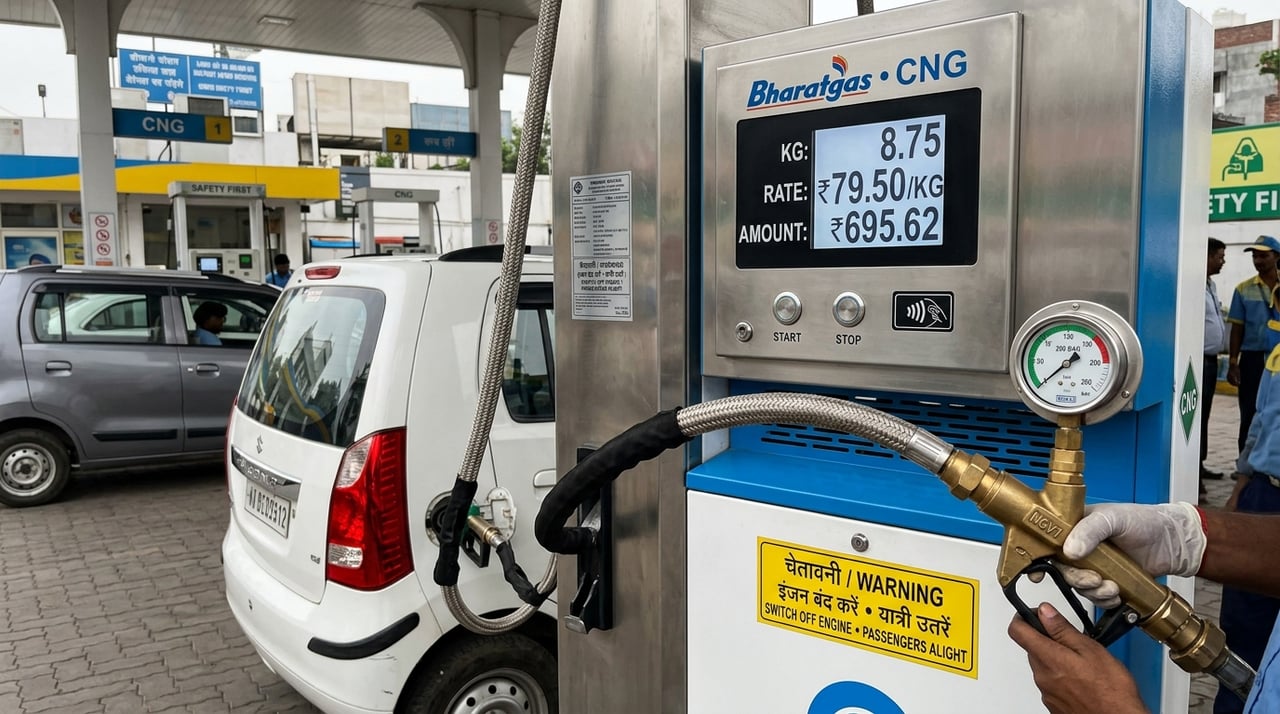
- Refuel During Off-Peak Hours (Morning Gas Density): Natural gas expands with temperature. Refueling between 6:00 AM and 8:30 AM before station dispensing manifolds heat up delivers up to 6% to 8% denser mass per fill. Use the CNGWALA Station Finder to track low-wait pump locations.
- Demand 200+ Bar Dispenser Pressure: Never accept a fill when dispenser manifold pressure sits below 180 bar. Inadequate pressure leaves your cylinder only 70% full, forcing you into redundant queue cycles.
- Calibrate Cold Tyre Pressures (+2 PSI): To counteract rear cylinder deadweight and reduce rolling resistance, maintain tyre pressures 2 PSI above OEM unladen specifications (e.g., 34 PSI instead of 32 PSI).
- Clean Air Filter Every 5,000 km: CNG relies on precise stoichiometric air-fuel combustion (17.2:1 ratio vs 14.7:1 for petrol). A dust-clogged air filter starves the engine of oxygen, spiking gas consumption by up to 12%.
- Always Start Engine on Pure Petrol: Modern factory-fitted sequential systems automate petrol warm-ups. Never force manual CNG ignition from cold starts, as cold cylinder walls cause fuel condensation and valve-seat strain.
9. Conclusion: The Verdict on 2025–2026 CNG Economics
Despite localized retail price adjustments over the past 24 months, Compressed Natural Gas remains India's most dependable engine of private wealth preservation.
For the average Indian commuter traveling 1,000 to 1,500 km per month, a factory-fitted CNG vehicle delivers ₹35,000 to ₹40,000 in net annual liquid savings after accounting for every rupee of maintenance, testing, and insurance. For intercity consultants and gig-economy fleet partners, those savings surge past ₹80,000 to ₹1,50,000 annually, rendering electric vehicles financially non-competitive due to steep upfront battery premiums.
If your odometer spins more than 35 kilometres each day, switching to factory CNG is not an expense—it is one of the highest-yielding low-risk investments you will ever make.
Official Data Sources & Regulatory Citations
All figures in this analysis are cross-referenced with primary Indian energy bodies.
Cite & Reference This Analysis
Free to reference in research papers, industry reports, news articles, and commercial blogs.
CNGWALA Financial & Mobility Research Team (2025). "How Much Can You Save With CNG in 1 Year? Real Case Studies". CNGWALA Mobility Intelligence. Retrieved from https://www.cngwala.com/blog/how-much-can-you-save-with-cng-in-one-year-real-life-indian-case-studies-title
[How Much Can You Save With CNG in 1 Year? Real Case Studies — CNGWALA Mobility Report](https://www.cngwala.com/blog/how-much-can-you-save-with-cng-in-one-year-real-life-indian-case-studies-title)