Converting Petrol Car to CNG in India: RTO Legal Guide & Costs
Everything you must know before converting a petrol car to CNG: Sequential vs Venturi kits, 5-stage RTO endorsement roadmap, ₹55k break-even audit, and insurance rules.
Complete sequential kit + 60L cylinder + RTO + insurance
At typical 40 km/day urban commute saving ₹4,500/month
₹3.60/km running cost vs ₹7.40/km on liquid petrol
Endorsed as "Petrol/CNG Dual Fuel" under MV Act Section 52
With retail petrol hovering persistently at ₹100 to ₹106 per liter across Indian cities, the economic pain of daily car ownership has become impossible to ignore. A 40-kilometer daily office commute burns nearly ₹8,000 every single month purely in liquid fuel.
For owners of petrol cars aged 3 to 10 years whose manufacturer warranties have already lapsed, a compelling solution beckons: converting the vehicle to Compressed Natural Gas (CNG).
The appeal is undeniable: cutting your monthly fuel bill by 50% to 55%, unlocking ₹45,000 to ₹60,000 in net annual household savings, and gaining immunity from volatile crude oil spikes.
Yet, aftermarket conversion is not as simple as dropping a metal tank into your boot.
Every year, thousands of Indian motorists fall into severe legal and mechanical traps: installing illegal uncertified kits, risking catastrophic intake manifold backfires from archaic Venturi mixers, or driving without RTO endorsement—which legally voids their insurance and triggers vehicle impoundment under Section 52 of the Motor Vehicles Act.
To help you convert safely, legally, and profitably, this comprehensive guide decodes the complete engineering, legal, and economic reality of retrofitting your petrol car to CNG.
⚙️ Sequential Injection vs. Venturi: The Non-Negotiable Choice
The single most critical mechanical decision in aftermarket conversion is kit architecture:
1. Obsolete Venturi / Mixer Kits (Avoid at All Costs)
- How They Work: Venturi kits are primitive mechanical systems developed in the 1990s. They utilize a mechanical mixer placed in front of the throttle body, drawing gas into the intake manifold purely via vacuum suction.
- The Fatal Flaws:
- They deliver uneven air-fuel mixtures across cylinders.
- In modern Multi-Point Fuel Injection (MPFI) or BS6 engines with plastic intake manifolds, lean air-fuel mixtures trigger violent intake backfires, shattering the expensive plastic intake manifold.
- They starve valves of proper thermal dissipation, trigger permanent Check Engine (MIL) warnings, and sap engine power by up to 25%.
- The Trap: Unscrupulous roadside garages offer Venturi kits for ₹25,000 to ₹30,000 to unsuspecting buyers looking for a bargain.
2. OBD-II Sequential Injection Kits (The Only Safe Choice)
- How They Work: Sequential kits mirror your car’s factory petrol injection architecture:
- A dedicated 32-bit Gas ECU connects directly to the vehicle’s On-Board Diagnostics (OBD-II) port.
- Gas is pressurized by a multi-stage heated reducer and fed to a separate gas injector rail mounted directly above the intake manifold runner of each individual cylinder.
- The Gas ECU reads millisecond fuel pulses from the petrol ECU and fires precise micro-doses of natural gas directly into each cylinder valve port.
- The Result: Seamless power delivery, negligible power loss (<5%), zero intake backfiring, zero Check Engine lights, and flawless transition between petrol and gas at highway speeds.
- Reputable Brands: Lovato, Motozen, Tomasetto Achille, BRC, Tartarini, and Greco.

📜 The 5-Stage Legal RTO Compliance Roadmap
Driving an unendorsed CNG car is illegal in India. If traffic police or RTO flying squads stop you, your car can be impounded under Section 52 of the Motor Vehicles Act. More critically, if you are involved in an accident, your insurance provider will repudiate 100% of claims due to an undeclared alteration of the vehicle’s fuel propulsion system.
Follow this verified 5-stage roadmap to ensure 100% legal roadworthiness:
Converting to CNG requires strict technical compliance under the Motor Vehicles Act to avoid impoundment and insurance claim repudiation. Ensure engine compression is healthy. If the car is on an active bank loan, obtain an official NOC from the financing bank before modifying the fuel system. Mount a government-certified sequential injection kit with dedicated gas injectors, 32-bit ECU, and PESO approved IS 15490 cylinder. Never install obsolete Venturi mixer kits. Verify high-pressure test certificate (300 bar) and ensure the brass compliance plate is riveted to the engine bay. Fuel pumps legally refuse refills without this plate. Submit Form 22, ARAI approval certificate, and chassis pencil print. The RTO inspects the car and updates your Registration Certificate to "PETROL/CNG DUAL FUEL". Submit the endorsed RC to your insurer to add the CNG system endorsement. Driving without insurance declaration risks 100% claim rejection in accidents.Petrol to CNG: The 5-Stage Legal Conversion Roadmap
Engine Health Verification & Hypothecation Clearance
OBD-II Sequential Injection Installation
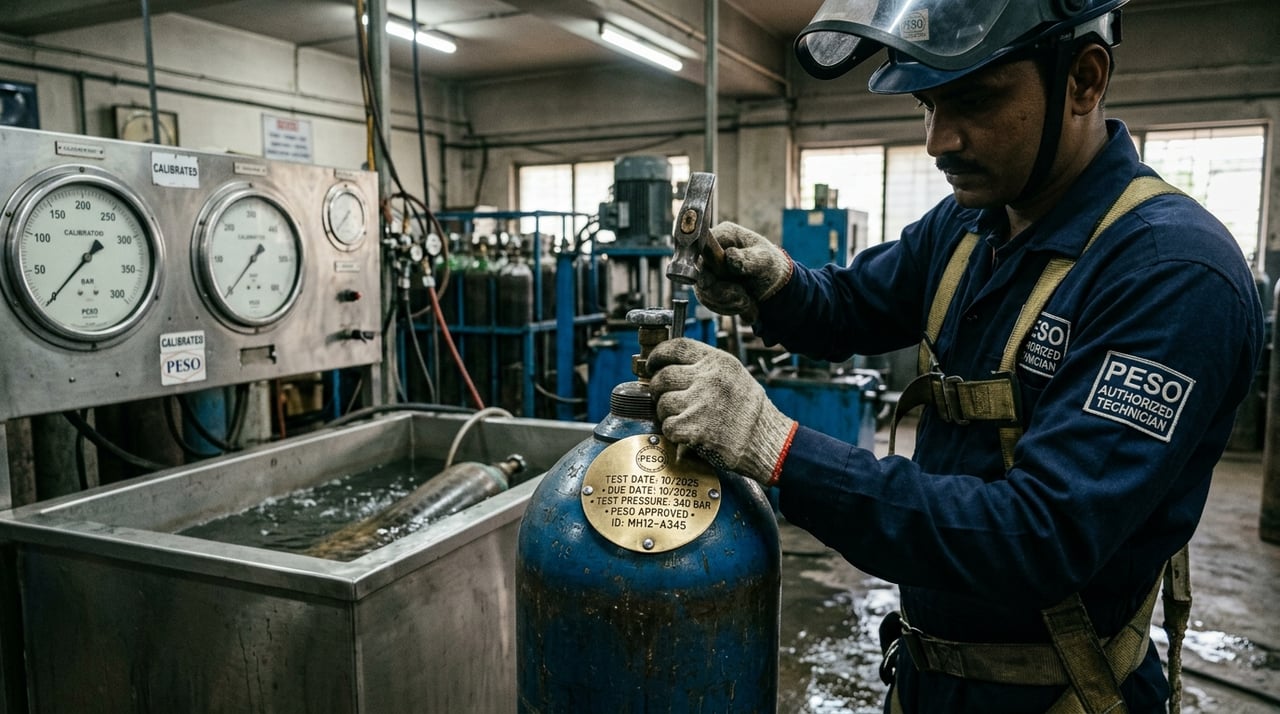
Hydrostatic Cylinder Testing & Brass Plate Riveting
Motor Vehicles Act Section 52 Fuel Endorsement
Insurance Policy Endorsement to Prevent Claim Rejection
💰 The Complete Retrofit Cost & Break-Even Audit
How much does a professional, legal conversion actually cost, and how fast will you recover your capital?
Itemized Out-of-Pocket Expenditure (2025–2026)
- Government-Approved OBD-II Sequential Kit: ₹42,000 – ₹52,000 (Includes 32-bit ECU, reducer, wiring harness, injector rail, micro-switch).
- PESO-Approved Seamless Steel Cylinder (60L / 12kg): ₹10,000 – ₹13,000 (Tested at 300 bar with initial hydro-test certificate).
- Professional Installation & Calibration Labor: ₹3,500 – ₹5,000.
- Official RTO Inspection & Smart-Card RC Endorsement: ₹1,800 – ₹3,200.
- Motor Insurance CNG Endorsement Premium: ₹800 – ₹1,200.
- Total Turnkey Capital Investment: ₹55,000 to ₹65,000.
The Break-Even Equation: 40 km Daily Commute
Consider a car owner driving 40 km per day (1,200 km/month):
- Petrol Running Cost (14 km/L at ₹104/L): ₹7.42 per km $\rightarrow$ ₹8,904 per month.
- CNG Running Cost (22 km/kg at ₹80/kg): ₹3.63 per km $\rightarrow$ ₹4,356 per month.
- Net Monthly Household Cash Saved: ₹4,548 per month.
$\text{Break-Even Period} = \frac{₹55,000 \text{ Turnkey Investment}}{₹4,548 \text{ Monthly Savings}} = \mathbf{12.1 \text{ Months}}$
Within just one year of normal commuting, the entire kit, installation, RTO fees, and insurance endorsement are 100% amortized. Every single kilometer driven thereafter represents pure financial profit.
⚖️ Factory-Fitted vs. Aftermarket Retrofit: Which Is Right for You?
| Evaluation Parameter | Factory-Fitted OEM (Maruti / Tata / Hyundai) | Aftermarket Sequential Retrofit (Approved Center) |
|---|---|---|
| Vehicle Eligibility | Brand new cars purchased directly from dealership showroom | Pre-owned or existing petrol cars (typically 2 to 10 years old) |
| Engine Modifications | Stellite-coated valves, hardened valve seats, dual ECU integration | Standard stock petrol engine; relies on sequential gas injector tuning |
| Manufacturer Warranty | 3 to 5 years (1,00,000 km) factory warranty 100% intact | Voids OEM engine/electrical warranty (best for cars past 3-year warranty) |
| Upfront Capital Premium | ₹85,000 to ₹95,000 above petrol showroom price | ₹50,000 to ₹60,000 turnkey retrofit cost (saves ₹30,000–₹40,000 upfront) |
| Boot Space Packaging | Tata twin-cylinder under-floor (preserves 85% boot); Maruti single tank | Standard 60L single cylinder consumes 60% of trunk luggage volume |
| RTO Paperwork | Zero effort; delivered directly from showroom with CNG endorsed on RC | Requires 7–14 days of documentation, physical RTO visit, and insurance update |
🔧 Post-Conversion Maintenance: Keeping Your Retrofit Healthy
To guarantee 1,50,000+ km of trouble-free driving from an aftermarket sequential kit:
- Replace the Low-Pressure Gas Filter Every 20,000 km: Natural gas contains microscopic compressor lubricating oil mists. A clean ₹800 spin-on gas filter protects expensive sequential injector needles from sticking.
- Use Iridium Spark Plugs: Natural gas requires 10% higher electrical breakdown voltage to ignite. High-performance iridium plugs prevent misfires and maintain peak fuel economy.
- Never Start Cold on CNG: Quality sequential kits automatically start the engine on petrol and switch to CNG only after coolant reaches 50°C. Never bypass this setting; running cold gas freezes the reducer diaphragm.
- Mandatory PESO Hydro-Testing Every 3 Years: Under the Gas Cylinder Rules 2016, every automotive cylinder must undergo hydrostatic testing every 36 months to verify wall elasticity and safety.
❓ Frequently Asked Questions (FAQ)
Will converting my car to CNG void my manufacturer warranty?
Yes. If your petrol car is within its active OEM manufacturer warranty period (typically the first 3 to 5 years), installing an aftermarket CNG kit immediately voids the manufacturer’s warranty on the engine, fuel injection system, and electrical harness. If your car is brand new, buying an OEM factory-fitted CNG car is strongly recommended. For vehicles past their warranty period, an aftermarket sequential conversion is extremely cost-effective.
Can an automatic (AMT/CVT/Torque Converter) petrol car be converted to CNG?
Yes. Modern OBD-II sequential injection kits interface with the transmission control module (TCM) to compensate for gear shift torque interruptions. Hundreds of thousands of AMT and torque-converter petrol hatchbacks operate seamlessly on sequential CNG without shifting shudder.
How do I check if an installer is officially authorized?
Ask the retrofit workshop for their State Transport Department Retrofitment License and the specific ARAI / iCAT Type Approval Certificate matching your vehicle’s exact make, model, and engine displacement code. Never install a kit from a shop that cannot provide vehicle-specific approval documentation.
Research Methodology & Regulatory Citations
All legal compliance procedures, RTO endorsement protocols, and safety standards in this report are cross-referenced with primary documentation from the Ministry of Road Transport and Highways (MoRTH), the Automotive Research Association of India (ARAI), the Petroleum and Explosives Safety Organisation (PESO), and the General Insurance Council of India (GIC).
Live station locator indices, community queue updates, and regional savings calculators are maintained by the CNGWALA Intelligence Platform.
Official Data Sources & Regulatory Citations
All figures in this analysis are cross-referenced with primary Indian energy bodies.
Cite & Reference This Analysis
Free to reference in research papers, industry reports, news articles, and commercial blogs.
CNGWALA Mobility Intelligence Team (2025). "Converting Petrol Car to CNG in India: RTO Legal Guide & Costs". CNGWALA Mobility Intelligence. Retrieved from https://www.cngwala.com/blog/everything-you-must-know-before-converting-your-petrol-car-to-cng
[Converting Petrol Car to CNG in India: RTO Legal Guide & Costs — CNGWALA Mobility Report](https://www.cngwala.com/blog/everything-you-must-know-before-converting-your-petrol-car-to-cng)