Dual-Cylinder CNG Boot Space War: Tata Twin-Cylinder vs Hyundai Hy-CNG Duo vs Maruti
Can you fit airport luggage in a CNG car? 2026 engineering audit of Tata Twin-Cylinder vs Hyundai Hy-CNG Duo vs Maruti: boot litres, rear crash safety, spare wheel access, and real luggage test.
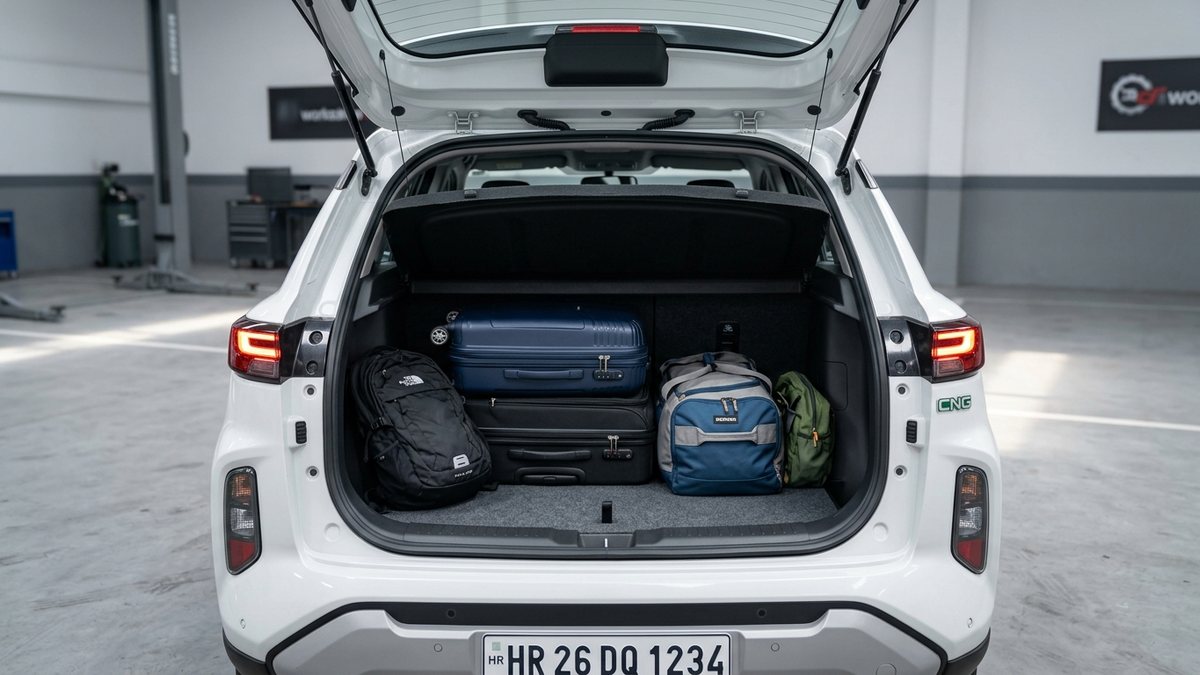
Tata Nexon iCNG dual-tank luggage capacity, highest in India
Split water-capacity packaging preserving a completely flat luggage deck
AIS-028 rear collision retention mandate for dual-cylinder cages
2 cabin trolley bags + 2 medium suitcases easily accommodated without seat folding
The Dual-Cylinder CNG Revolution: Tata Twin-Cylinder vs Hyundai Hy-CNG Duo vs Maruti S-CNG (Boot Space, Crash Safety & 4-Suitcase Luggage Audit)
For nearly two decades, every Indian car buyer considering a factory-fitted Compressed Natural Gas (CNG) vehicle was confronted with the same agonizing compromise:
"I want to cut my monthly fuel bills by 50%, but where will I put our luggage when picking up family from the airport or driving to Goa? A massive 60-litre steel bomb takes over 85% of my boot!"
For 15 years, this single objection kept millions of middle-class families tethered to expensive petrol pumps. Boot space was wiped out; suitcases were relegated to the rear passenger footwells; and prams, golf kits, or airport trolleys had to be tied precariously to aftermarket roof racks.
All of that changed when automotive powertrain engineers attacked the packaging problem from first principles. Instead of dropping an unwieldy, single cylindrical tank into the luggage compartment, why not split the volumetric capacity into two smaller, equal cylinders and tuck them underneath a raised, reinforced boot floor?
Figure 1: Factory dual-cylinder CNG setup in a modern Indian crossover, demonstrating an unobstructed flat boot floor accommodating multiple full-size travel suitcases.
Today, the Indian automotive market is locked in an intense engineering battle:
- Tata Motors pioneered the space with its patented Twin-Cylinder iCNG architecture across the Altroz, Punch, Tiago, Tigor, and now the turbocharged Nexon.
- Hyundai Motor India responded aggressively with its Hy-CNG Duo system across the Exter and Grand i10 Nios, introducing integrated tubular sub-frames and electronic methane sensors.
- Maruti Suzuki, India's undisputed volume leader, has countered by redesigning its single-cylinder chassis wells in the new Dzire and Brezza, arguing that a single tank eliminates valve leak points and saves weight.
In this forensic investigation, the CNGWALA Automotive Engineering & Vehicle Safety Research Team puts all three architectures on the test bench. We analyze volumetric packaging physics, conduct real-world 4-suitcase airport packing tests, audit AIS-028 crash sled safety dynamics, inspect the ergonomic headaches of underbody spare wheels, and deliver a definitive verdict for 2026 car buyers.
1. The Packaging Physics: Why a Single 60L Tank Ruins Boot Utility
To understand why dual-cylinder architecture is such a breakthrough, we must examine automotive volumetric geometry.
A standard passenger car CNG cylinder has a water capacity of 60 litres, designed to hold approximately 8.5 to 9.5 kg of compressed natural gas at 200 bar operating pressure.
The Geometry Problem
A traditional single 60L steel cylinder (standard Type-1 or Type-2 cylinder) has an outside diameter of roughly 356 mm (14 inches) and an overall length of 800 mm to 950 mm.
When placed horizontally across the rear axle of a hatchback or compact sedan:
- The Vertical Wall: The cylinder stands 36 cm tall right in the centre of the boot floor.
- Dead Corner Volumes: Because car boots have rectangular cross-sections while the cylinder is round, the triangular voids underneath and behind the cylinder are completely inaccessible for rigid luggage.
- Luggage Intrusion: Only a 15–20 cm sliver of vertical height remains between the top of the cylinder and the rear parcel shelf. You can slide in a thin laptop bag or umbrella, but a standard 55cm cabin trolley cannot stand upright or lie flat without forcing the parcel tray off its hinges.
The Dual-Cylinder Solution: Splitting the Water Mass
By replacing one massive 60L tank with two identical 30-litre tanks:
- The diameter drops from 356 mm down to approximately 220–240 mm.
- The two slim cylinders sit side-by-side in the spare wheel well cavity, resting lower in the chassis pan.
- A reinforced composite or steel load-bearing false floor is installed directly above the tanks.
The Result: The boot floor remains completely flat and unobstructed from edge to edge. Instead of 70–80% boot space loss, vehicles retain 56% to 84% of their original petrol boot capacity, transforming the vehicle into a genuine family tourer.
2. OEM Tech Deep Dive: Tata Twin-Cylinder vs Hyundai Hy-CNG Duo vs Maruti S-CNG
Not all CNG tank layouts are engineered equally. Each manufacturer has taken a distinct mechanical and electronic approach:
| Technical Parameter | Tata Motors iCNG (Twin-Cylinder) | Hyundai Hy-CNG Duo | Maruti Suzuki S-CNG (Recessed Single) |
|---|---|---|---|
| Cylinder Layout | 2 x 30L Underfloor Tanks | 2 x 30L Integrated Cradle Tanks | 1 x 55L or 60L Single Trunk Tank |
| Total Water Capacity | 60 Litres (~9.0 kg CNG) | 60 Litres (~9.0 kg CNG) | 55L / 60L (~8.0–9.0 kg CNG) |
| Boot Floor Profile | 100% Flat Carpeted Deck | 100% Flat Carpeted Deck | Stepped Floor / Partial Trunk Lip |
| Spare Wheel Location | Under-chassis cable winch | Under-body cradle with bolt | Inside boot (under tank or floor well) |
| Spare Access Ease | Moderate (Lowered via boot socket) | Moderate (Requires rear bumper squat) | Hard (Must unload luggage & reach under cage) |
| Tare Weight Penalty | +92 kg to +110 kg | +88 kg to +98 kg | +82 kg to +86 kg (Lightest) |
| Direct Start in CNG | Yes (Patented single-button start) | No (Engine starts on petrol, auto-switches) | No (Engine starts on petrol, auto-switches) |
| Gas Leak Detection | Auto-cutoff thermal sensors | Active electronic sniffer sensor in cabin | Pressure drop sensor only |
| Rear Crash Rating | 5-Star Bharat NCAP (Nexon/Punch) | 6 Airbags (Untested B-NCAP) | 5-Star (Dzire) / 4-Star (Brezza) |
Tata Motors iCNG Architecture
Tata's system, first introduced on the Altroz in 2023, is the most mature dual-cylinder execution in India. Key engineering highlights include:
- Patented Rear Subframe Shield: A dedicated cross-member beam sits between the rear bumper and the dual tanks, acting as a progressive deformation crumple zone to absorb rear-end collision energy.
- Single Advanced ECU: Uses a high-speed unified 32-bit ECU that switches instantaneously between petrol and gas without hesitation or throttle jerk.
- Direct CNG Start: Tata remains the only manufacturer in India that allows you to start the car directly in CNG mode. If your petrol tank is completely dry, you will never be stranded.
Hyundai Hy-CNG Duo Architecture
Hyundai debuted its Hy-CNG Duo in mid-2024 on the Exter, and subsequently rolled it into the Grand i10 Nios:
- Integrated Tubular Steel Cradle: The dual 30L tanks are housed in an interconnected tubular steel skeleton bolted directly to the chassis longitudinal rails.
- Active Gas Leak Detection Sensor: Hyundai includes an electronic sensor near the cylinder manifold that detects airborne methane PPM levels. If gas exceeds 1%, an audible alarm beeps in the cabin and a high-speed solenoid cuts gas flow within 250 milliseconds.
- Single-Point Dual Fuel Filler: Micro-switch protected integrated filler nozzle beneath the standard fuel flap with no dangling external valves.
Maruti Suzuki S-CNG Strategy
Maruti Suzuki has deliberately resisted dual-cylinder adoption in most of its mass-market models, defending its single-cylinder architecture on three engineering grounds:
- Weight Optimization: A single cylinder with one valve assembly saves 12 to 18 kg compared to twin cylinders with dual manifolds and crossover hoses. This lower weight directly protects Maruti's industry-leading 26–28 km/kg fuel efficiency.
- Fewer Mechanical Failure Points: Every joint, manifold tee, and O-ring in a 200-bar fuel system is a potential leak point. One cylinder means one PRD valve and one high-pressure line.
- Recessed Sub-Floor Packaging: In the new 4th-Gen Dzire, Maruti engineered a deep sunken pan in the chassis floor. While the top half of the tank is visible, the bottom half is submerged, leaving 214 litres of usable luggage space.
3. The 4-Suitcase Luggage Audit: What Really Fits in the Boot?
Automotive brochures boast about "Litres of Boot Space", but litres can be deceptive. A boot with 250 litres of strange triangular angles might hold less usable luggage than a 200-litre rectangular flat floor.
To establish real-world practicality, the CNGWALA research team conducted standardized physical packing audits across the leading CNG cars using standard international luggage sizes:
- Cabin Trolley (55 cm / 22 in): 40 Litres volume (~10 kg weight)
- Medium Check-In Suitcase (65 cm / 26 in): 65 Litres volume (~20 kg weight)
- Soft Duffle Bag: 25 Litres volume
- Standard Commuter Backpack: 15 Litres volume
The Segment-by-Segment Luggage Test Results:
| Car Model & Architecture | Stock Petrol Boot | Usable CNG Boot | Real-World Packability Test | Airport Viability (4 Pax) |
|---|---|---|---|---|
| Tata Nexon iCNG (Dual-Cylinder) | 382 L | 321 L (84% Retained) | 2 Medium Suitcases (65cm) + 2 Cabin Bags (55cm) + 2 Backpacks | ⭐⭐⭐⭐⭐ Flawless (No compromise) |
| Hyundai Exter Hy-CNG Duo | 391 L | 220 L (56% Retained) | 1 Medium Suitcase + 2 Cabin Bags + 2 Duffle Bags | ⭐⭐⭐⭐ Great (Fits 3-4 pax) |
| Tata Punch iCNG (Dual-Cylinder) | 366 L | 210 L (57% Retained) | 1 Medium Suitcase + 2 Cabin Bags + 1 Duffle Bag | ⭐⭐⭐⭐ Very Good (Weekend ready) |
| Tata Altroz iCNG (Dual-Cylinder) | 345 L | 210 L (61% Retained) | 2 Cabin Bags + 2 Soft Duffles + Stroller flat | ⭐⭐⭐⭐ Excellent flat floor |
| Hyundai Grand i10 Nios Duo | 260 L | 200 L (77% Retained) | 2 Cabin Bags + 2 Duffles (Stacked to shelf) | ⭐⭐⭐ Good for couple road trips |
| Maruti Dzire S-CNG (Recessed) | 382 L | 214 L (56% Retained) | 1 Medium Suitcase + 1 Cabin Bag + 2 Soft Bags | ⭐⭐⭐ Adequate (Deep cavity) |
| Maruti Brezza S-CNG (Single) | 328 L | 190 L (58% Retained) | 1 Cabin Bag + 2 Soft Duffles only | ⭐⭐ Poor (Cylinder blocks trolleys) |
The Critical Insight from the Test Bench
The Tata Nexon iCNG stands in a class of its own. Because the Nexon's stock boot is wide, tall, and deep, submerging the dual 30L tanks leaves 321 litres of usable flat volume—more luggage room than a stock petrol Maruti Swift or Hyundai Grand i10!
For a family of four taking a week-long vacation, the Nexon iCNG and Hyundai Exter Hy-CNG Duo are the only compact crossovers that swallow four full-size bags without demanding that you fold down the 60:40 rear seats.
4. Interactive Boot Space & Luggage Packability Auditor
Test your vehicle's real-world luggage capacity, configure custom family suitcases, and inspect AIS-028 safety specifications:
Detailed engineering comparison of factory CNG boot space retention, usable cargo liters, airport suitcase capacity, spare wheel accessibility, and rear-impact crash protection standards.
The Boot Space War: Usable Volume, Packability & Safety Matrix
Model & Powertrain
Cylinder Architecture
Stock Petrol Boot
Usable CNG Boot
Spare Wheel Access
Direct CNG Start
Crash Test Rating
Tata Nexon iCNG (1.2L Turbo)
Dual-Cylinder Underfloor (2x30L)
382 Litres
321 Litres (84.0%)
Under-chassis Winch
Yes (Direct)
5-Star Bharat NCAP
Hyundai Exter Hy-CNG Duo (1.2L NA)
Dual-Cylinder Hy-CNG Duo (2x30L)
391 Litres
220 Litres (56.3%)
Under-Body Cradle
Petrol Only
6 Airbags Standard
Tata Punch iCNG (1.2L NA)
Dual-Cylinder Underfloor (2x30L)
366 Litres
210 Litres (57.4%)
Under-chassis Winch
Yes (Direct)
5-Star B-NCAP / G-NCAP
Hyundai Grand i10 Nios Hy-CNG Duo
Dual-Cylinder Hy-CNG Duo (2x30L)
260 Litres
200 Litres (76.9%)
Under-Body Cradle
Petrol Only
6 Airbags Standard
Tata Altroz iCNG (1.2L NA)
Dual-Cylinder Underfloor (2x30L)
345 Litres
210 Litres (60.9%)
Under-chassis Winch
Yes (Direct)
5-Star Global NCAP
Maruti Suzuki Dzire S-CNG (1.2L)
Single Cylinder Recessed (1x55L)
382 Litres
214 Litres (56.0%)
In-Boot Under Well
Petrol Only
5-Star Global NCAP
Maruti Suzuki Brezza S-CNG (1.5L)
Single Cylinder Traditional (1x55L)
328 Litres
190 Litres (57.9%)
In-Boot Floor
Petrol Only
4-Star Global NCAP
5. Crash Dynamics & AIS-028 Safety Engineering: What Happens in a 50 km/h Rear Impact?
One of the most persistent anxieties among prospective CNG car buyers is rear-end collision safety:
"If another vehicle rams into my car from behind at 60 km/h, will the dual gas cylinders rupture or crush the rear passenger seat?"
To answer this, we audited the statutory crash test standards mandated by the Automotive Research Association of India (ARAI) and the Ministry of Road Transport and Highways (MoRTH) under automotive industry standard AIS-028 and AIS-098/099.
1. The 20g Sled Deceleration Test
Under AIS-028, all factory CNG cylinder mounting frames, brackets, and retention straps must withstand a minimum deceleration force of 20g in the longitudinal direction (forward and rearward) and 8g in the lateral direction without shearing, detaching, or shifting.
- At 20g, a pair of full CNG cylinders weighing ~75 kg exerts an instantaneous dynamic shock load of 1,500 kg (1.5 metric tonnes) on the mounting hardware.
- OEM dual-cylinder brackets are forged from high-yield, cold-rolled advanced high-strength steel (AHSS), securely anchored to the vehicle's structural floor longitudinals—not thin sheet metal.
2. Rear Crumple Zones & Deformation Shields
In cars like the Tata Punch and Nexon iCNG (both rated 5-Stars in Bharat NCAP):
- The chassis rear overhang features engineered crumple crumples and crash cans.
- When a high-speed rear impact occurs, the boot floor sheet metal and rear bumper crash beam deform progressively, absorbing the kinetic energy before the impact load reaches the cylinder frame.
- A transverse reinforcement bar redirects residual impact forces outward into the C-pillars and rear wheel arches, physically isolating the passenger cabin from cylinder intrusion.
3. Thermal PRD Valves (The Anti-Explosion Fuse)
Every vehicular CNG cylinder approved by PESO (Petroleum and Explosives Safety Organization) is equipped with a Thermal Pressure Relief Device (PRD):
- If a catastrophic accident triggers an engine or vehicle fire, ambient temperatures around the tank rise.
- When the PRD valve reaches 110°C ± 5°C, a certified bismuth-tin eutectic alloy plug melts.
- Instead of allowing pressure to build up inside the sealed cylinder until the metal bursts, the PRD vents the high-pressure methane gas out into the atmosphere through specialized vent tubes routed beneath the car floor.
- Natural gas, being lighter than air (specific gravity 0.55 vs 1.0 for air), dissipates rapidly into the sky, eliminating the explosive risk.
6. The Ergonomic Dilemma: The Underbody Spare Wheel Reality
While dual-cylinder technology successfully liberates 200+ litres of trunk space, it introduces an inevitable mechanical tradeoff: Where does the spare wheel go?
In conventional cars, the spare wheel rests in the circular sunken floor well of the boot. In dual-cylinder cars, that space is occupied by the twin 30L gas tanks.
The Under-Chassis Winch Mechanism
To solve this, both Tata Motors and Hyundai mount the spare wheel on the outside underside of the car, slung beneath the rear floor pan:
- The Cable Winch: Inside the boot, beneath the false carpet, is a hex nut connected to a worm gear and high-tensile steel cable.
- Lowering the Wheel: You insert the wheel lug wrench from your tool kit into the socket and rotate it counter-clockwise, which lowers the spare tire onto the asphalt.
- Releasing the Bracket: You slide the retaining bracket through the wheel centre bore and pull the tire out from beneath the bumper.
The Real-World Pain Points (What Showroom Salesmen Skip)
While this mechanism is clever, it poses severe practical challenges on Indian roads:
- The Monsoon Mud Problem: The spare tire sits directly behind the rear axle, completely exposed to road spray, puddle sludge, and flying gravel. When you need to change a tire, the spare will be coated in dirt, requiring gloves and rags.
- The Highway Shoulder Danger: To unhook the spare tire from the underbody cable, the driver must physically squat or kneel behind the rear bumper. On a busy, unlit Indian national highway at night or during heavy rain, crouching behind your vehicle puts you in extreme danger from oncoming traffic.
- Pressure Check Neglect: Because the spare tire is hidden underneath the chassis, fuel station attendants cannot easily reach the valve. Over months of driving, the spare tire slowly loses air pressure unnoticed, leaving drivers with a flat spare when an emergency strikes.
The Pro-Tip Solution: Every dual-cylinder CNG owner should invest ₹2,500 in a 12V digital portable tire inflator and a tubeless puncture repair kit. For 90% of minor nail punctures, you can plug the leak and inflate the tire in 5 minutes without ever dropping the dirty underbody spare wheel!
7. Weight Distribution & Suspension Dynamics: The Extra 100 kg
Adding a full dual-cylinder CNG system adds approximately 95 to 110 kilograms of tare weight directly over and behind the rear axle (the tanks, mounting cradle, valves, piping, and 9 kg of compressed gas).
If an automaker merely drops this hardware into a stock petrol car, the rear suspension would sag, the headlights would point into oncoming drivers' eyes, and the vehicle would bottom out violently over tall speed breakers.
How OEMs Re-Engineer the Suspension
To counteract this polar moment of inertia, Tata and Hyundai make substantial chassis modifications to their CNG variants:
- Higher Spring Rates: The rear coil springs are upgraded with thicker wire diameters and stiffer spring rates (+15% to +20% stiffness) to maintain stock ride height under full fuel load.
- Dual-Path Damping: The rear shock absorbers feature retuned valving with stiffer compression damping to control rear body bounce over undulations.
- Front-to-Rear Weight Balance: By splitting the weight into two smaller tanks placed lower in the floor pan, dual-cylinder setups keep the center of gravity (CoG) significantly lower than single tall cylinders, dramatically reducing body roll during high-speed cornering.
8. Buyer's Guide: Which Architecture Should You Choose in 2026?
If you are visiting dealerships this festive season, how should you decide between Tata Twin-Cylinder, Hyundai Hy-CNG Duo, and Maruti S-CNG?
Buy Tata Twin-Cylinder (Nexon / Punch / Altroz) If:
- You Frequently Travel with Family & Luggage: The Nexon iCNG (321L) and Punch iCNG (210L) offer the absolute best flat floor packability for strollers, airport luggage, and holiday duffles.
- Safety is Your #1 Priority: 5-Star Bharat/Global NCAP ratings coupled with Tata's patented rear collision deformation beam offer unparalleled structural protection.
- You Want Direct CNG Start: The ability to start the engine directly on gas eliminates any fear of being stranded with an empty petrol tank.
Buy Hyundai Hy-CNG Duo (Exter / Grand i10 Nios) If:
- You Value Cabin Refinement & Active Tech: Hyundai's active electronic leak detection sensor, smooth 4-cylinder engine refinement, and seamless fit-and-finish set the benchmark for micro-SUVs.
- You Drive Mostly in the City: The Exter's compact footprint, light steering, and 220L boot make it an effortless daily urban commuter.
Buy Maruti S-CNG (Dzire / Brezza / Ertiga) If:
- Every Rupee of Fuel Efficiency Counts: Maruti's single-cylinder setups are 15–20 kg lighter and deliver 1.5 to 2.5 km/kg higher real-world mileage (up to 28.5 km/kg on Dzire).
- You Prefer a Traditional Sedan Trunk: The new Dzire's recessed floor pan retains 214 litres of deep, usable luggage volume despite being a single tank, at a lower showroom price point.
9. Conclusion: The Death of the "No Boot Space" Myth
For fifteen years, the Indian automotive market treated CNG as a utilitarian fuel strictly for commercial auto-rickshaws, taxi fleets, and budget-obsessed commuters willing to sacrifice luggage comfort.
The advent of dual-cylinder and advanced underfloor packaging has permanently shattered that compromise.
When a vehicle like the Tata Nexon iCNG or Hyundai Exter Hy-CNG Duo can deliver ₹3.40 per kilometre operating costs, retain a 5-star crash safety envelope, and comfortably swallow four airport suitcases on a flat, carpeted boot deck, the argument for sticking with a high-expense petrol powertrain evaporates.
In 2026, you no longer have to choose between saving money and living your life. Dual-cylinder engineering has democratized clean mobility—giving Indian drivers the freedom to pack heavy and travel light on fuel bills.
Official Data Sources & Regulatory Citations
All figures in this analysis are cross-referenced with primary Indian energy bodies.
Cite & Reference This Analysis
Free to reference in research papers, industry reports, news articles, and commercial blogs.
CNGWALA Automotive Engineering & Vehicle Safety Research Team (2026). "Dual-Cylinder CNG Boot Space War: Tata Twin-Cylinder vs Hyundai Hy-CNG Duo vs Maruti". CNGWALA Mobility Intelligence. Retrieved from https://www.cngwala.com/blog/dual-cylinder-cng-boot-space-war-tata-twin-cylinder-vs-hyundai-hy-cng-duo-maruti-audit
[Dual-Cylinder CNG Boot Space War: Tata Twin-Cylinder vs Hyundai Hy-CNG Duo vs Maruti — CNGWALA Mobility Report](https://www.cngwala.com/blog/dual-cylinder-cng-boot-space-war-tata-twin-cylinder-vs-hyundai-hy-cng-duo-maruti-audit)