Delhi-NCR Winter GRAP Bans: Why CNG is the Ultimate Shield Against ₹20,000 Challans
CAQM Stage III & IV vehicle ban survival guide for Delhi-NCR. Full analysis of the ₹20,000 Section 194(1) penalty on BS3/BS4, CNG/EV exemptions, checkpost hotspots, and fuel ledger economics.
Mandatory fine under Section 194(1) MV Act for driving banned BS3/BS4 vehicles
Round-the-clock exemption from CAQM Stage III & IV vehicular plying bans
Real-world commuting cost in Delhi-NCR vs ₹6.20/km for BS-IV diesel
Average fuel expenditure reduction for daily 60 km intercity NCR drivers
Delhi-NCR Winter GRAP Bans: Why CNG is the Ultimate Shield Against ₹20,000 Challans (Fleet & Commuter Survival Guide)
As late October transitions into November, the National Capital Region (Delhi, Noida, Gurugram, Faridabad, Ghaziabad, and Sonipat) experiences its annual environmental crisis: the onset of dense winter thermal inversion, agricultural stubble smoke, and toxic particulate matter stagnation. When the Air Quality Index (AQI) crosses the dreaded 400-mark into the "Severe" and "Severe+" zones, the Commission for Air Quality Management (CAQM) triggers Stage III and Stage IV of the Graded Response Action Plan (GRAP).
For over 5.5 lakh registered private car owners and tens of thousands of commercial delivery operators across NCR, this regulatory trigger is catastrophic. Overnight, BS-III Petrol and BS-IV Diesel private four-wheelers are barred from operating on any public road, under penalty of an immediate, mandatory ₹20,000 challan under Section 194(1) of the Motor Vehicles Act, 1988.
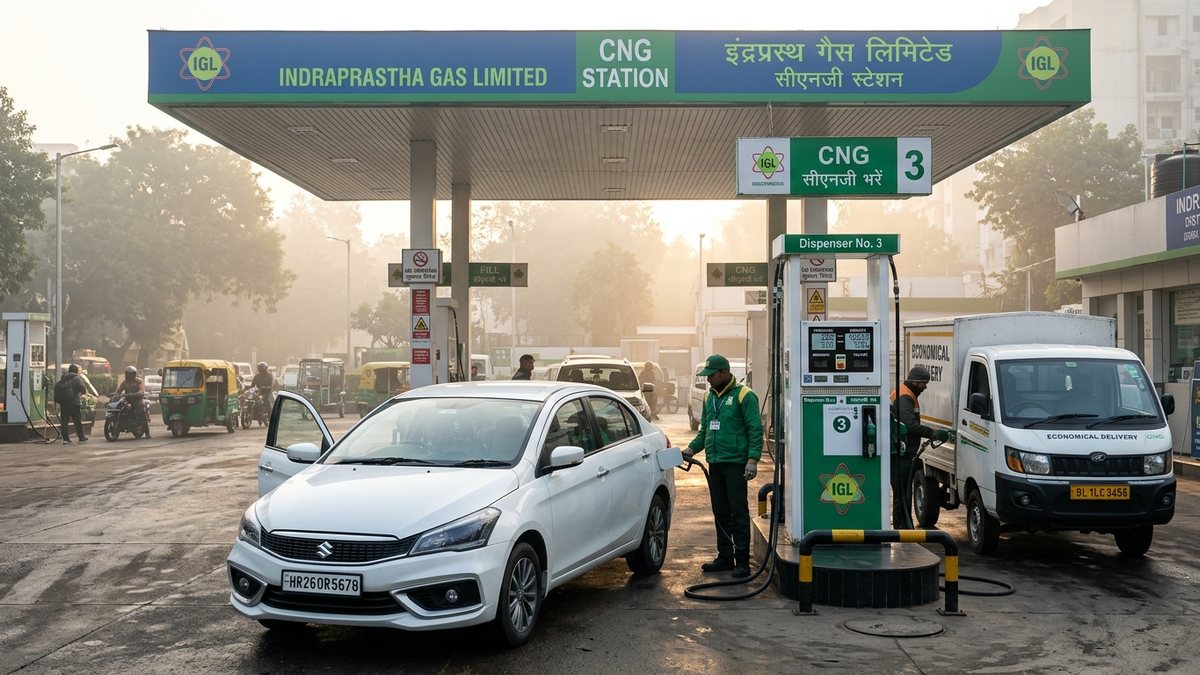
Figure 1: Clean factory-fitted CNG sedans and commercial delivery vans refueling uninterrupted at an Indraprastha Gas Limited (IGL) station in Delhi-NCR on a winter morning.
Amidst this annual regulatory lockdown, one mobility powertrain emerges not just as an eco-friendly alternative, but as an unshakeable, 100% legally immune shield: Compressed Natural Gas (CNG) and Bio-CNG (CBG).
In this comprehensive editorial audit, the CNGWALA Urban Mobility & Environmental Policy Research Team deconstructs the legal mechanics of CAQM GRAP directives, analyzes the exact traffic police enforcement hotspots across NCR border checkposts, calculates the true financial ledger comparing diesel penalties with CNG fuel economics, and explores the unique thermal density advantages of winter CNG refueling.
1. The GRAP Regulatory Architecture: Understanding Stages I to IV
The Graded Response Action Plan is a statutory emergency framework originally instituted pursuant to Supreme Court orders and now administered under statutory authority by the Commission for Air Quality Management in NCR & Adjoining Areas Act, 2021.
Unlike general traffic regulations, GRAP escalates progressively based on 24-hour ambient air quality telemetry monitored by the Central Pollution Control Board (CPCB):
| GRAP Stage | Ambient Air Quality Trigger | Core Vehicular Actions & Enforcement Directives |
|---|---|---|
| Stage I (Poor) | AQI 201 – 300 | Periodic mechanized road sweeping, water sprinkling, strict verification of valid PUC certificates, zero idling drives at traffic junctions. |
| Stage II (Very Poor) | AQI 301 – 400 | Heightened parking tariffs across municipal zones to discourage private vehicle usage, augmented bus and Delhi Metro frequencies, synchronized traffic signals. |
| Stage III (Severe) | AQI 401 – 450 | Total prohibition on plying of BS-III Petrol and BS-IV Diesel LMVs (4-wheelers) in NCT Delhi, Gurugram, Faridabad, Ghaziabad, Gautam Buddh Nagar, and Sonipat. Non-Delhi registered diesel LGVs barred from entry unless carrying essential supplies. |
| Stage IV (Severe+) | AQI > 450 | All Stage III restrictions maintained. Total ban on entry of outstation diesel Medium and Heavy Goods Vehicles (MGVs/HGVs) into Delhi. Discretionary odd-even formula for private four-wheelers. |
Under both Stage III and Stage IV, the vehicular mandate is unequivocal:
- BS-III Petrol Cars: Prohibited from plying.
- BS-IV Diesel Cars: Prohibited from plying.
- Factory-Fitted CNG Vehicles: 100% EXEMPT & ALLOWED.
- Certified Retrofitted CNG (Endorsed in RC): 100% EXEMPT & ALLOWED.
- Electric Vehicles (EVs): 100% EXEMPT & ALLOWED.
- BS-VI Petrol & Diesel Vehicles: Permitted to operate.
2. The ₹20,000 Financial Trap: Section 194(1) Motor Vehicles Act
Many NCR motorists mistakenly assume that a winter GRAP violation incurs a nominal traffic fine of ₹500 or ₹1,000. In reality, the legal penalty is among the most punitive in the entire Indian Motor Vehicles Act.
Under Section 194(1) of the Motor Vehicles (Amendment) Act, 2019:
"Whoever drives a motor vehicle or causes or allows a motor vehicle to be driven in contravention of the provisions of section 113 or section 114 or section 115 shall be punishable with a fine of twenty thousand rupees."
Because CAQM invokes Section 115 of the MV Act to publish plying prohibitions in the official gazette, every traffic enforcement agency (Delhi Traffic Police, Haryana Police in Gurugram/Faridabad, and UP Traffic Police in Noida/Ghaziabad) issues a flat statutory challan of ₹20,000 per violation.
The Un-Compoundable Nature of the Fine
Unlike minor lane-driving infractions or speeding tickets that can be compounded or settled at virtual traffic courts for reduced amounts, CAQM anti-pollution challans are strictly un-compoundable. They cannot be settled on the spot for a discounted fee.
Furthermore, traffic enforcement authorities possess statutory powers under Section 207 of the MV Act to impound the vehicle on the spot if the driver is unable to produce immediate documentation or attempts repeat plying.
Automated ANPR Camera Interception
The era of relying on human traffic constables waving a stick is over. Across Delhi-NCR, the transport departments have integrated their Intelligent Traffic Management Systems (ITMS) with high-speed Automatic Number Plate Recognition (ANPR) camera gantries:
- Camera Capture: The overhead gantry camera snaps high-definition photos of the front and rear registration plates.
- Vahan Database Handshake: The ANPR engine queries the national Parivahan / Vahan 4.0 database within 350 milliseconds.
- Norm & Fuel Verification: If the vehicle's registered fuel type is "DIESEL" with emission norm "BHARAT STAGE IV", or "PETROL" with "BHARAT STAGE III", an electronic challan is generated automatically.
- SMS Notification: The owner receives an automated SMS with photographic evidence and a ₹20,000 payment notice within minutes, regardless of whether a physical policeman was present.
3. High-Risk NCR Border Hotspots: Where the Barricades Are Set
For commuters traveling across state lines within the National Capital Region, the risk of interception during GRAP-3 and GRAP-4 is concentrated at major arterial border choke points.
Joint enforcement task forces comprising the State Transport Department, Delhi Traffic Police, and local municipal corporations operate 24-hour inspection cordons at the following primary corridors:
1. Delhi – Noida Corridor (DND Flyway & Kalindi Kunj)
- Checkpost Locations: DND Toll Plaza approach gantry, Mayur Vihar Pocket-1 border, and Kalindi Kunj Yamuna Bridge.
- Enforcement Profile: Multi-lane ANPR camera gantries coupled with physical transport barricades. All outstation diesel light commercial vehicles are subjected to physical RC scrutiny.
2. Delhi – Gurugram Corridor (Sirhaul & Kapashera)
- Checkpost Locations: NH-48 Sirhaul Toll Plaza (Ambience Mall stretch) and Kapashera Border near Old Delhi-Gurgaon Road.
- Enforcement Profile: High-density peak-hour physical barricading. Traffic police funnel traffic into dedicated verification lanes, halting commercial delivery vans and older diesel luxury SUVs.
3. Delhi – Ghaziabad Corridor (Anand Vihar & Ghazipur)
- Checkpost Locations: Ghazipur border flyover descent, Anand Vihar ISBT entry point, and Apsara Border (Shahdara).
- Enforcement Profile: Extreme vigilance on outstation buses and goods carriers. Non-BS-VI diesel buses entering from Uttar Pradesh and Uttarakhand are turned back or impounded.
4. Delhi – Faridabad Corridor (Badarpur Border)
- Checkpost Locations: Badarpur Flyover toll plaza and Mathura Road ground bypass.
- Enforcement Profile: Heavy checking of industrial freight coming from Faridabad's manufacturing belts into South Delhi.
5. Delhi – Haryana North (Singhu & Tikri Borders)
- Checkpost Locations: Singhu Border on GT Karnal Road (NH-44) and Tikri Border on Rohtak Road.
- Enforcement Profile: Primary commercial freight interception hubs where long-haul diesel HGVs are diverted to Western Peripheral Expressway (KMP) and Eastern Peripheral Expressway (KGP).
4. The Clean Fuel Immunity: Why Factory CNG & Bio-CNG Are Exempt
Why does the Commission for Air Quality Management provide unconditional, round-the-clock plying exemption to CNG and Bio-CNG vehicles?
The answer lies in combustion chemistry and tailpipe emission stoichiometry:
- Zero Particulate Matter (PM2.5 and PM10): Natural gas is composed of >90% methane (CH4), the simplest hydrocarbon molecule with only one carbon atom. Because it mixes homogeneously in gaseous phase with air, CNG combustion produces virtually zero soot, zero smoke, and zero particulate matter, which constitute the primary hazardous components of winter smog.
- 85% Lower Oxides of Nitrogen (NOx): Unlike high-compression diesel engines that generate extreme localized peak combustion temperatures causing nitrogen and oxygen to synthesize into toxic NOx, modern sequential CNG injection runs cooler and cleaner with standard 3-way catalytic converters.
- Bio-CNG (CBG) Carbon Neutrality: Under the Ministry of Petroleum and Natural Gas (MoPNG) SATAT initiative, Bio-CNG is produced via anaerobic biomethanation of agricultural crop residue (paddy straw / parali) and animal manure. By converting the very paddy straw that would otherwise be burned in fields into vehicle fuel, Bio-CNG actively neutralizes winter air pollution at both ends of the lifecycle.
5. Interactive Compliance & Challan Auditor
Audit your vehicle's regulatory status, calculate your potential ₹20,000 fine exposure under active GRAP phases, and evaluate your exact fuel ledger savings by transitioning to factory-fitted CNG:
Audit vehicle legal status under CAQM Stage III & IV winter pollution controls, calculate ₹20,000 fine liabilities, and evaluate net fuel ledger savings by transitioning to factory-fitted CNG.
The Delhi-NCR GRAP Ban & ₹20,000 Challan Risk Simulator
Vehicle Class & Norm
GRAP Stage III / IV Status
Real Running Cost
Challan Exposure
Annual CNG Savings
BS-IV Diesel (Private Car)
STRICTLY BANNED
₹6.20 / km
₹20,000 / offense
Loss: ₹50,250 / yr
BS-III Petrol (Private Car)
STRICTLY BANNED
₹7.60 / km
₹20,000 / offense
Loss: ₹71,250 / yr
BS-VI Petrol (Modern Car)
Permitted
₹6.55 / km
₹0
CNG saves ₹55,500 / yr
Factory OEM CNG (WagonR, Dzire, Nexon iCNG)
100% EXEMPT & IMMUNE
₹2.85 / km
₹0 (Zero Risk)
Benchmark Zero-Delta
6. The Winter Fuel Ledger: Real-World Economics for NCR Commuters
Beyond eliminating the existential dread of a ₹20,000 challan, how do the daily running economics of an OEM CNG vehicle compare with BS-IV diesel and modern BS-VI petrol in real-world NCR traffic?
Let us audit a standard Delhi-NCR daily commuter traveling 50 km round-trip (e.g., Noida Sector 62 to Connaught Place or Gurugram Cyber City to Dwarka) over a typical 90-day winter smog period (November 1 to January 31).
Pump Tariff Benchmarks (October 2026):
- IGL CNG (Delhi NCT): ₹75.09 / kg
- IGL CNG (Noida / Greater Noida / Ghaziabad): ₹79.70 / kg
- Haryana City Gas (Gurugram): ₹80.12 / kg
- Retail Diesel (Delhi): ₹87.62 / Litre
- Retail Petrol (Delhi): ₹94.72 / Litre
90-Day Commuter Expense Matrix (4,500 km Driving):
| Parameter | BS-IV Diesel Car (e.g. Swift DDiS / Creta CRDi) | BS-VI Petrol Car (e.g. Baleno / i20 1.2) | Factory OEM CNG Car (e.g. WagonR / Dzire / Nexon iCNG) |
|---|---|---|---|
| Real Stop-Go Mileage | 14.1 km / Litre | 13.8 km / Litre | 25.8 km / kg |
| Running Cost Per KM | ₹6.21 / km | ₹6.86 / km | ₹2.91 / km |
| 90-Day Fuel Expenditure | ₹27,945 | ₹30,870 | ₹13,095 |
| Challan Risk Under GRAP-3/4 | ₹20,000 (Mandatory fine) | ₹0 (Exempt) | ₹0 (100% Immune) |
| Total 90-Day Outflow Risk | ₹47,945 | ₹30,870 | ₹13,095 |
| Net Savings with CNG | ₹34,850 Saved | ₹17,775 Saved | Benchmark Zero-Delta |
The "Single Challan Rule"
Consider the stark financial reality of the data above: A single ₹20,000 traffic fine on a banned BS-IV diesel car is equivalent to purchasing 266 kilograms of CNG—enough to power a factory CNG vehicle for nearly 7,000 kilometres of driving, or nearly 5 months of daily 50 km commuting!
7. The Winter Refueling Advantage: Cold Ambient Pressure Physics
One of the best-kept secrets among seasoned Delhi-NCR CNG drivers is the thermodynamic winter filling advantage.
Have you ever noticed that your CNG cylinder takes in significantly more kilograms of gas during a chilly December morning than on a blistering 44°C June afternoon?
This is governed by the Ideal Gas Law with real-gas compressibility factor (Z): Density rho = (P * M) / (Z * R * T)
Where P is dispenser delivery pressure (standard 200 bar), V is cylinder water capacity (standard 60 litres in sedans), and T is ambient absolute temperature (in Kelvin).
The Summer vs. Winter Filling Comparison:
- Summer Peak (42°C / 315 K): Gas molecules expand and thermal agitation increases pressure prematurely at the dispenser nozzle cutoff. A 60-litre water-capacity tank typically accepts only 7.6 to 8.1 kg of CNG before reaching the 200-bar limit.
- Winter Morning (10°C / 283 K): Cold ambient air dramatically increases methane gas density. At the identical 200-bar dispenser cutoff, the exact same 60-litre tank packs in 8.9 to 9.4 kg of CNG!
What This Means on the Road:
- 16% Extra Range per Tank: That extra 1.3 kg of gas delivers an immediate 32 to 36 kilometres of additional highway range on a single fill.
- Reduced Queue Frequency: Higher single-fill capacity means you refuel once every 4 to 5 days instead of every 3 days.
- Queue Strategy: To maximize this physics advantage, refuel early in the morning (between 6:00 AM and 8:30 AM) when ambient temperatures are at their lowest and compressor cascades at IGL mother stations are fully charged.
8. The E-Commerce & Commercial Freight Revolution: CNG Light Goods Vehicles
While private commuters suffer personal inconvenience, the commercial logistics sector faces existential threats during winter pollution peaks.
Under CAQM Stage III and IV, diesel-operated Light Goods Vehicles (LGVs) and Medium Goods Vehicles (MGVs) registered outside Delhi are strictly barred from entering the capital unless carrying emergency life-saving supplies.
For courier companies, FMCG distributors, and e-commerce giants (Amazon, Flipkart, Blinkit, Zepto, BigBasket), November through January represents the peak festive and wedding delivery quarter. A transportation shutdown during this period results in millions of rupees in lost revenue and SLA breach penalties.
The Mass Commercial Migration to CNG LGVs
This regulatory pressure has fueled an explosive migration toward small commercial clean vehicles:
- Tata Ace Gold CNG Plus: Features an 8.2 kg onboard gas capacity delivering an ARAI-certified range of 375+ km, allowing uninterrupted intra-city multi-drop deliveries across Delhi, Noida, and Gurugram.
- Maruti Suzuki Super Carry CNG: Powered by a 1.2L 4-cylinder engine with a 70-litre water-capacity CNG cylinder, offering a payload capacity of 625 kg with zero GRAP entry restrictions.
Commercial delivery operators report that running CNG delivery vans provides two decisive advantages:
- 24/7 Unrestricted Border Mobility: Green commercial vehicles pass through border toll checkpoints without harassment or forced U-turns.
- 42% Operating Cost Reduction: At ₹3.20 to ₹3.50 per kilometre running cost compared to ₹5.80 to ₹6.40 for diesel mini-trucks, logistics fleets save approximately ₹14,000 per vehicle per month.
9. RTO & PESO Compliance Checklist: Shielding Yourself at Checkpoints
While factory-fitted CNG vehicles are exempt from GRAP plying prohibitions, driving a CNG vehicle does not grant automatic immunity if your vehicle documentation is flawed.
During high-alert GRAP Stage III/IV drives, traffic police and RTO enforcement squads actively inspect vehicle credentials to detect fraudulent CNG stickers and uncertified retrofits.
To ensure frictionless transit across NCR borders, maintain the following four compliance documents:
- RC Fuel Endorsement: Vahan registration certificate MUST explicitly state "CNG" or "PETROL/CNG". Unendorsed kits violate Section 52 of the MV Act.
- PESO Hydro-Testing Plate: Mandatory metal compliance plate affixed near the filling valve or under bonnet with valid test date (testing required every 3 yrs).
- Valid Green PUC Certificate: Delhi-NCR enforces strict 3-month PUC validity for gas vehicles. Expired PUC attracts a flat ₹10,000 fine under Section 190(2).
- Micro-Switch Interlock Functional: Ensure fuel lid micro-switch is intact; engine must not start while fuel filler cap is open (mandated under AIS-028 safety).
The 3-Year PESO Hydro-Testing Rule
Under the Gas Cylinder Rules, 2016 administered by the Petroleum and Explosives Safety Organization (PESO):
- Every vehicular CNG cylinder must undergo mandatory hydrostatic re-testing every three years from the date of initial commissioning.
- Testing stations subject the cylinder to hydraulic water pressure at 300 bar (1.5 times working pressure) to inspect for volumetric expansion, micro-fractures, or structural fatigue.
- Upon passing, a stamped aluminum compliance identification plate is riveted to the vehicle structure, and a digital test certificate is uploaded to the Vahan portal.
- Warning: If your hydro-test plate is expired, traffic police can reject your clean-fuel exemption claim and treat your vehicle as an uncertified hazard, impounding the car under PESO regulations.
10. Conclusion: Turn Winter Vulnerability into Year-Round Wealth
The annual Delhi-NCR air pollution crisis is a grim environmental reality that will not disappear overnight. For the foreseeable future, motorists living in Delhi, Noida, Gurugram, Faridabad, and Ghaziabad must plan around the virtual certainty that BS-III petrol and BS-IV diesel vehicles will be banned for 30 to 60 days every single winter.
Continuing to rely on an aging BS-IV diesel sedan or older petrol hatchback in the National Capital Region is a financial gamble. You are one ANPR camera flash away from a catastrophic ₹20,000 challan—a penalty that instantly wipes out any perceived savings from delaying a vehicle upgrade.
By transitioning to a modern factory-fitted CNG or Bio-CNG vehicle:
- You gain 100% legal immunity against seasonal plying prohibitions across all NCR checkposts.
- You slash your daily commuting fuel expenditure by 50% to 58%, putting ₹45,000 to ₹70,000 back into your bank account every year.
- You actively curb toxic tailpipe soot and particulate matter, doing your civic part to clean the air our families breathe.
This winter, do not let pollution lockdowns dictate your freedom of mobility. Drive clean, drive legal, and let CNG be your ultimate shield.
Official Data Sources & Regulatory Citations
All figures in this analysis are cross-referenced with primary Indian energy bodies.
Cite & Reference This Analysis
Free to reference in research papers, industry reports, news articles, and commercial blogs.
CNGWALA Urban Mobility & Environmental Policy Research Team (2026). "Delhi-NCR Winter GRAP Bans: Why CNG is the Ultimate Shield Against ₹20,000 Challans". CNGWALA Mobility Intelligence. Retrieved from https://www.cngwala.com/blog/delhi-ncr-grap-winter-bans-cng-anti-challan-shield-guide
[Delhi-NCR Winter GRAP Bans: Why CNG is the Ultimate Shield Against ₹20,000 Challans — CNGWALA Mobility Report](https://www.cngwala.com/blog/delhi-ncr-grap-winter-bans-cng-anti-challan-shield-guide)